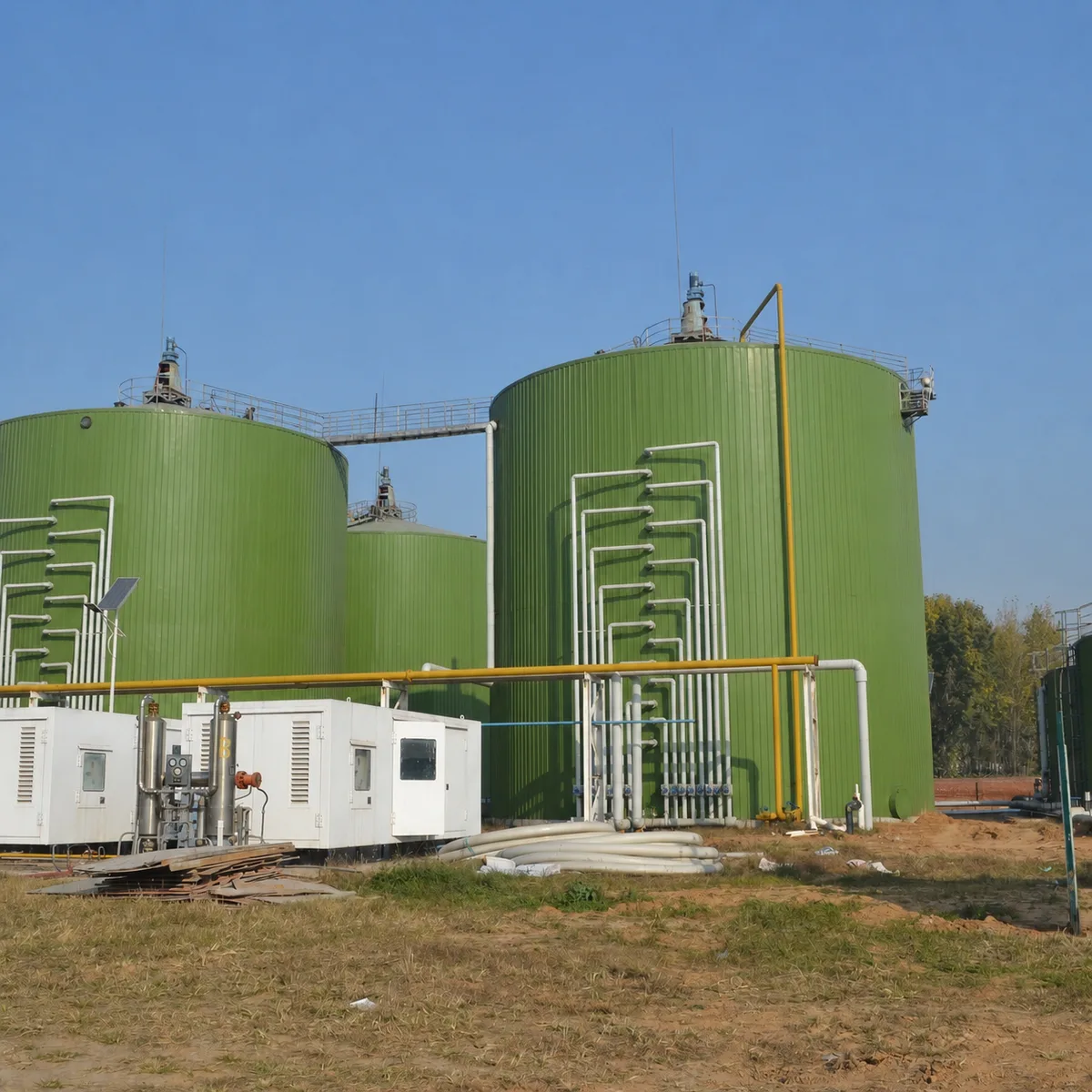
Application guide for gas holders serving compressed-biogas plants, covering gas balance, buffering, pressure control interfaces, condensate, safety scope, and RFQ data.
A gas holder is a buffer within a defined gas-management system; gas composition, pressure, control, safety, and interface responsibilities must be documented together.
Gas Storage Must Match the Upgrading Sequence
Compressed-biogas facilities generally need to manage the difference between variable raw-gas production and the conditions required by downstream treatment, upgrading, compression, use, or controlled disposal. A gas holder can provide temporary buffer volume, but it is not a stand-alone guarantee of gas quality, plant throughput, pressure safety, or emissions performance. The project must define the gas source, time-based production range, composition, moisture and contaminants, normal and abnormal pressure cases, downstream equipment envelope, and the complete control and safety concept.
This page focuses on the holder and its interfaces. For the broader digestion context, see the biogas and anaerobic digestion page. The selected arrangement must be reviewed by responsible process and safety engineers for the specific facility and applicable local requirements.
Compressed Biogas Gas-Holder Inputs
Review area
Information required for a comparable proposal
Gas balance
Minimum, normal, peak, and upset generation profile; expected downtime; buffer objective; downstream consumption or upgrading profile; flare or alternate disposal strategy.
Gas condition
Methane and carbon-dioxide range, oxygen, hydrogen sulfide, moisture, temperature, condensate, particulates, and treatment sequence.
Holder and controls
Usable buffer basis, membrane or holder configuration, pressure and vacuum limits, blower or control interface, isolation, alarms, relief, detection, and emergency logic.
Site interface
Tank or foundation interface, drainage, access, hazardous-area basis, electrical and controls boundary, lifting, installation, inspection, commissioning, and documents.
Use a Time-Based Gas Balance
Raw biogas production may vary with feedstock, digestion temperature, mixing, maintenance, and upstream operating conditions. Downstream upgrading and compression equipment may have different operating limits. The project should state the flow profile, required buffer duration, minimum and maximum gas generation, expected downtime, pressure range, and what happens when the holder reaches high or low limits. A single nominal volume does not establish whether the arrangement can support the intended operating sequence.
The enquiry should also name the boundary of gas treatment. Dehumidification, desulfurization, carbon-dioxide removal, compression, odorization, flare, and utilization equipment may be separate packages. The quotation should say whether the holder receives raw or treated gas and which party supplies associated valves, instruments, pipework, controls, and safety systems.
Treat Composition and Condensate as Design Inputs
Gas composition, moisture, hydrogen sulfide, oxygen, temperature, and condensate can affect materials, joints, drains, instrumentation, maintenance, and the suitability of connected equipment. The owner should issue representative and design data, including upset or cleaning conditions where relevant. No material or membrane statement should be generalized from a different feedstock or treatment sequence.
Condensate management needs a practical routing plan. Identify low points, drains, traps, insulation or heat tracing where specified, maintenance access, disposal route, freeze exposure where relevant, and who supplies the equipment outside the holder package. These are operational interfaces, not afterthoughts.
Define Pressure, Isolation, and Safety Responsibilities
Pressure and vacuum cases should be stated with the operating and control philosophy. The project must identify isolation, relief, detection, alarms, trips, manual response, emergency shutdown, electrical classification where applicable, and the responsible party at each battery limit. The holder, pipework, treatment plant, and control system form one connected arrangement; no single component should be assumed to provide the whole facility safety function.
For configuration context, compare the required duty with the single and double membrane roof page. Final design must follow the selected equipment configuration, approved calculations, and the project safety review.
Issue an RFQ That Makes Bids Comparable
A strong RFQ states the gas balance, composition, holder duty, pressure envelope, accessories, control and safety interfaces, site constraints, installation method, testing, commissioning, documentation, spares, and exclusions. It should make clear whether the buyer wants a holder only, a holder connected to a tank, or a broader package with explicitly listed interfaces.
Use the industrial tank RFQ data checklist to coordinate process, tank, civil, electrical, control, and site inputs. That approach prevents the holder quotation from being mistaken for an unspecified complete compressed-biogas plant.
Plan Operating Access and Handover Early
The selected arrangement needs a practical operating route for routine inspection, membrane or component replacement where relevant, drainage, instrument calibration, isolation, and emergency intervention. Identify safe access, platforms, lifting, temporary works, weather exposure, electrical supply, controls enclosure, and the installation boundary. These details determine whether the package can be installed and maintained within the available plot and shutdown windows.
Handover should identify the supplied configuration, drawings, inspection records, installation instructions, operating limits, maintenance information, spares, and testing responsibilities. The buyer should distinguish component records from plant acceptance evidence. A supplier can document its own supplied equipment, while process performance, safety integration, and local acceptance remain part of the defined project responsibility. The completed file should identify the responsible organization for each open interface and define the test evidence required before gas is introduced.
Data to Include in the RFQ
A compressed-biogas gas-holder RFQ should start with the documented gas balance and safety basis, then connect them to the selected holder, controls, site, installation, and handover interfaces.
Time-based gas-generation profile, gas composition and contaminants, temperature, moisture, condensate, upstream treatment, downstream upgrading or compression envelope, flare or alternate disposal path.
Required buffer function and usable volume basis, holder configuration, pressure and vacuum limits, attachments, access, drains, inspection, maintenance, and replacement route.
Isolation, relief, pressure control, detection, alarms, electrical and controls interfaces, hazardous-area information, emergency response, and responsibility at battery limits.
Tank or foundation interface, site access, lifting, weather, utilities, drainage, installation, testing, commissioning, documents, spare parts, and handover requirements.