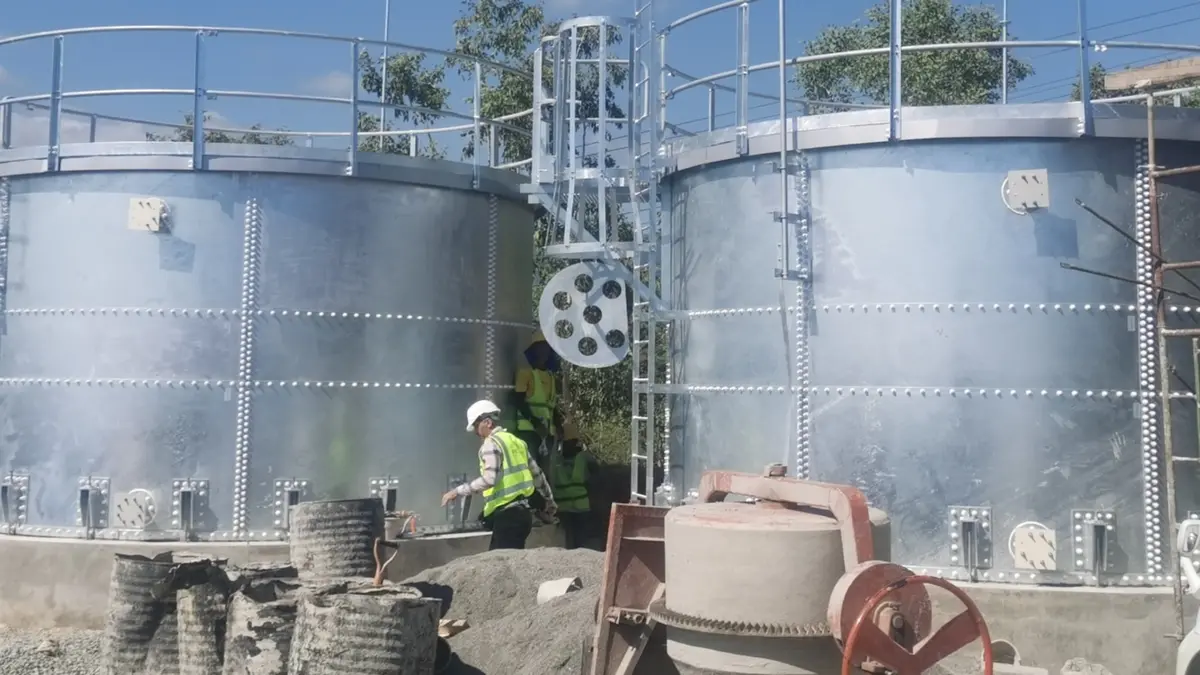
Fire water tank guide covering reserve volume, pump suction, accessories, site loads, inspection, scope boundaries, and RFQ data.
A fire water tank must preserve the required usable reserve and coordinate with pump suction, refill, alarms, access, and the site fire protection design.
Treat fire water storage as part of the protection system
A fire water tank is a life-safety component, not an ordinary utility-water vessel. Its usable reserve, minimum operating level, refill assumptions, pump suction arrangement, alarms, and availability must support the fire scenarios defined by the responsible fire protection designer. Nominal shell volume alone does not show whether the system can deliver the required flow for the required duration.
Projects may use glass-fused-to-steel, fusion bonded epoxy, galvanized bolted, stainless steel, welded steel, or concrete tanks. The appropriate construction depends on the governing project documents, usable capacity, site loads, water chemistry, approval route, erection access, inspection expectations, and maintenance plan. Product claims should not replace the hydraulic and fire-risk design completed for the facility.
Usable fire-water volume, design flow, duration, simultaneous demand, dead storage, freeboard, minimum suction level, and whether refill is credited.
Hydraulic interface
Pump arrangement, suction nozzle size and elevation, anti-vortex provisions, pipe loads, test return, refill rate, overflow, drain, and isolation philosophy.
Tank system
Construction type, roof, vent, water chemistry, internal and external corrosion protection, nozzles, ladders, platforms, level instruments, and alarms.
Site conditions
Location, wind, seismic, snow, temperature and freeze risk, geotechnical basis, foundation, drainage, containment, access, security, and construction constraints.
Compliance and scope
Authority, insurer and owner requirements; named standard and edition; design responsibility; inspection; testing; installation; commissioning; and handover records.
Calculate usable reserve, not only nominal capacity
The capacity basis should come from the approved fire strategy or hydraulic design. Buyers should state the required fire flow and duration, simultaneous hose, monitor, hydrant, sprinkler or foam demand where applicable, and any reliable refill allowance accepted by the reviewing authority. The tank proposal should distinguish nominal geometric volume from usable fire reserve after minimum suction level, inaccessible bottom volume, operating level tolerance, overflow setting, and freeboard are considered.
Where a tank shares water with domestic or process users, the design must prevent non-fire consumption from reducing the protected reserve. This can require dedicated compartments, separate outlet elevations, controls, or a fully dedicated tank. The responsible fire protection engineer and approving authority should accept the arrangement before procurement; the tank supplier cannot infer the required reserve from facility size alone.
Coordinate pump suction and hydraulic details early
Suction performance depends on more than nozzle diameter. The design team should coordinate pump type, suction-pipe geometry, water level range, nozzle elevation, anti-vortex provisions, entrance losses, pipe supports and reactions, isolation valves, and the possibility of air entrainment. Large or poorly located nozzles can also create local shell loads that must be included in the structural review.
The nozzle schedule should cover fill, suction, overflow, drain or washout, test return, recirculation if any, level instruments, low-level alarm, sampling, and access. Overflow and drain discharge must be routed safely so a test, overfill, or maintenance activity does not undermine the foundation. Pump-house, piping, electrical power, controls, and network commissioning are often by other parties, so each interface needs a named owner.
Select construction for water, environment, and site access
Factory-coated bolted tanks can simplify transport and field assembly for remote or constrained sites. The quotation should identify coating or galvanizing system, panel edges, fasteners, gasket material, roof connection, repair procedure, packing protection, and installation inspection. Welded steel tanks may fit large atmospheric storage or project specifications that require site fabrication, but welding procedures, nondestructive examination, coating, weather control, and field quality records must be planned.
Water chemistry, disinfectant exposure, coastal atmosphere, industrial fallout, temperature cycling, and internal condensation influence corrosion protection. Cold climates add freeze protection for pipes, valves, vents, overflow, instruments, and roof drainage. Site wind, seismic and snow actions, foundation tolerances, anchor design, vehicle access, security, and fire-service access should be supplied before final engineering.
Apply the correct authority and standard hierarchy
The governing hierarchy normally begins with destination-country law and the requirements of the authority having jurisdiction, civil defense or fire service, insurer, owner, and project contract. A named industry standard can then define tank features, inspection, or acceptance where it has been adopted. The RFQ should identify the document title, edition, amendments, and any owner deviations instead of saying only that the tank must be fire approved.
NFPA 22 is a United States-origin consensus standard for water tanks used in private fire protection. It is widely referenced internationally, but it is not global law and should be applied only when the project authority, insurer, owner, or contract adopts it. Requirements can differ in other jurisdictions, so bidders must not present NFPA language as a universal substitute for local approval.
Plan inspection, testing, and continued availability
The inspection and test plan should match the construction system and governing documents. Typical records may include approved drawings, material certificates, coating or galvanizing reports, weld and nondestructive examination records where applicable, dimensional checks, foundation acceptance, erection inspection, hydrostatic test procedure and results, nozzle and accessory verification, repair records, and final as-built information.
Handover should also define operating levels, alarm set points, refill testing, valve positions, inspection access, cleaning, corrosion monitoring, freeze precautions, and the process for taking the tank out of service. A fire reserve remains dependable only when the owner protects it from unauthorized drawdown, detects low level, maintains access and water quality, and coordinates outages with the site fire-safety plan.
Standards and Reference Notes
The National Fire Protection Association describes NFPA 22 as the Standard for Water Tanks for Private Fire Protection. It is a U.S.-origin consensus standard, not a worldwide legal requirement. Use the edition and amendments adopted by the project authority, insurer, owner, or contract, together with all destination-country and local requirements.
Next RFQ Steps
Send required usable fire reserve, flow and duration basis, minimum water level, refill assumptions, pump suction and nozzle schedule, tank construction, roof, site loads, climate, foundation status, governing documents, inspection, and installation scope.