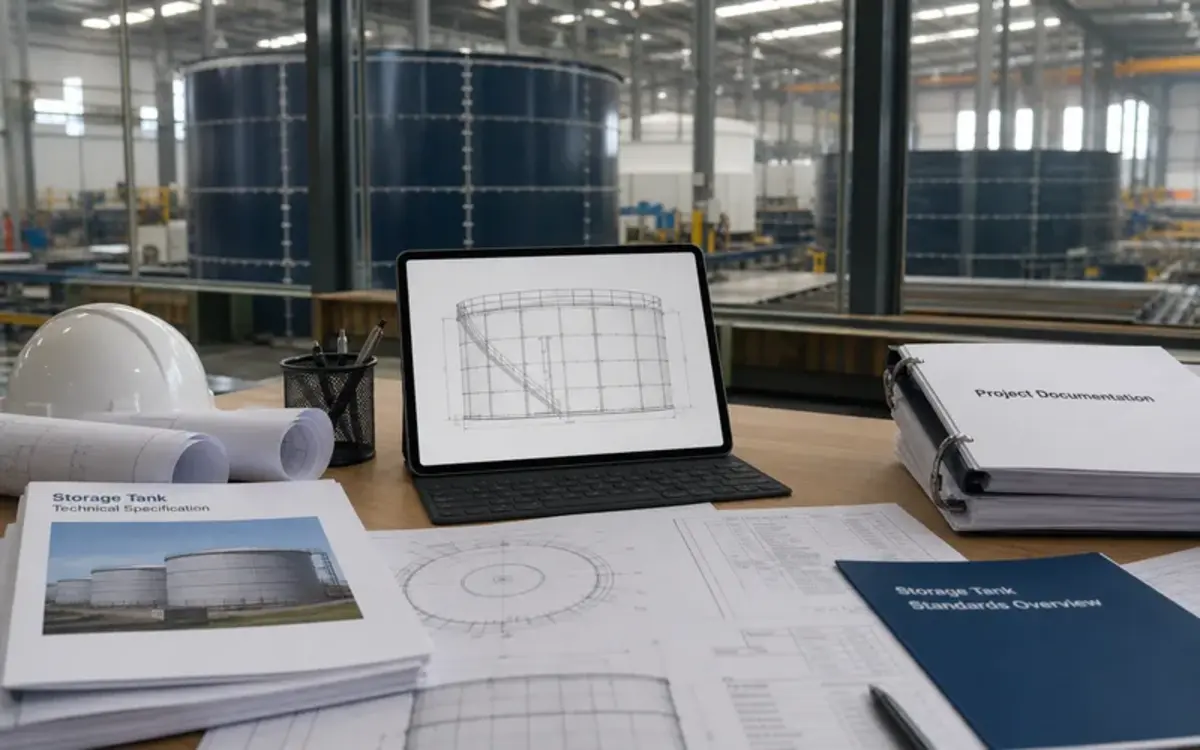
Industrial tank design standards guide covering API 650, API 620, AWWA D100, AWWA D103, ISO 28765, and local site load data.
Design standards should be selected by tank type, stored media, pressure, water service, coating system, and local structural requirements.
Tank Design Standards Buyers Should Confirm
A tank standard is not a marketing label. It defines the engineering basis used for shell design, roof design, bottom/foundation interface, inspection, fabrication, documentation, and sometimes coating or appurtenance expectations. The correct standard depends on tank type and service duty.
For welded atmospheric storage, buyers often discuss API 650. Low-pressure welded storage may involve API 620. Welded water tanks may reference AWWA D100, while factory-coated bolted steel tanks may reference AWWA D103. Glass-fused-to-steel bolted tanks for water and wastewater may reference ISO 28765. Final compliance must be confirmed by the project engineer, local authority, and contract documents.
Common Standard Mapping
Standard
Typical Use in Buyer Review
API 650
Welded aboveground atmospheric storage tanks, often for oil, fuel, petrochemical, and industrial liquid storage.
API 620
Large welded low-pressure storage tanks where pressure/vacuum conditions exceed typical atmospheric tank assumptions.
AWWA D100
Welded carbon steel tanks for water storage applications, subject to project-specific water authority requirements.
AWWA D103
Factory-coated bolted carbon steel tanks for water storage and related duties, depending on owner specification.
ISO 28765
Vitreous and porcelain enamelled bolted steel tanks for water, wastewater, and industrial effluents.
What the Supplier Needs Before Design
A standard alone is not enough. The manufacturer still needs capacity, diameter/height preference, stored media, design temperature, specific gravity, corrosion allowance if applicable, roof load, wind speed, seismic data, nozzle schedule, access requirements, and inspection scope.
When buyers request an API 650 welded steel tank or an AWWA bolted tank, the quotation should separate structural design, coating/lining, accessories, documentation, packing, and installation support. Use this page with the RFQ data checklist.
Procurement Scope and Handover Notes
Tank Design Standards Buyers Should Confirm should be reviewed as part of a complete storage system. Before final pricing, the buyer should confirm whether the supplier scope includes engineering drawings, material or coating records, roof and accessory supply, packing protection, installation documents, and commissioning support.
For international RFQs, the same tank volume can lead to different quotations if site loads, corrosion data, inspection requirements, approval standards, or installation responsibility are missing. A stronger inquiry clearly separates confirmed data from assumptions so the supplier can respond with a comparable technical proposal.
Next RFQ Steps
Send the required standard, stored media, capacity, site loads, drawings, inspection scope, and approval documents. If the standard is not fixed yet, describe the project duty and local approval path.
Use a project hierarchy rather than a universal-standard claim
Tank requirements normally begin with destination-country law, local authority decisions, owner specifications, contractual documents, and the responsible engineer’s design basis. Industry standards can define construction, loading, inspection, or performance where they are adopted, but a document originating in one country or sector is not automatically global law.
The RFQ should identify each required document by title, edition, amendments, and project deviations. General phrases such as international standard or globally approved are too vague for engineering or commercial comparison. If the governing basis is undecided, suppliers should be asked to state the basis used for budget pricing.
Match the standard to tank type and service
Atmospheric welded tanks, bolted water tanks, pressure vessels, fire-water tanks, potable-water systems, dry bulk silos, roofs, and gas holders may fall under different document families. Pressure and vacuum, stored medium, construction method, temperature, site loads, consequence of failure, and approval route determine which requirements are relevant.
A named standard does not eliminate project inputs. Capacity, geometry, corrosion allowance or coating, roof and venting, nozzles, external loads, wind, seismic, snow, foundation, inspection, testing, and documentation still need definition. The supplier should disclose assumptions where the project specification leaves them open.
Control edition, interfaces, and deviations
Standard editions can change, and owner supplements may be more restrictive than the base document. Procurement should freeze the applicable edition before final design and state how conflicts are resolved. Mixing selected clauses from several standards without a hierarchy can create contradictory requirements and unclear acceptance criteria.
The final compliance matrix should distinguish tank-supplier scope from civil, process, piping, electrical, fire-protection, environmental, and commissioning responsibilities. Inspection and handover records should demonstrate conformance for the supplied package without implying approval of the complete facility.
Set a hierarchy before citing a design standard
A tank standard is one input to a project basis, not a substitute for it. The owner specification, legally applicable requirements, authority conditions, site loads, process duty, contract scope, and the named edition of any selected standard should be arranged in a clear order of precedence. When documents conflict, the buyer should request a written clarification rather than asking a supplier to silently choose the less demanding interpretation.
The standard must also fit the equipment and service being supplied. Atmospheric liquid storage, pressurized equipment, bolted panels, welded shells, water-contact duty, roofs, and accessory steelwork can bring different design and approval considerations. The relevant question is not which standard name appears most often in supplier material, but which requirements govern the exact tank package and which parts of the package fall outside that standard.
Use the RFQ data checklist to record the owner documents, design basis, geography, loads, stored media, inspection scope, and approval route. This produces a usable engineering brief before a quotation is compared.
Freeze assumptions before a budget proposal becomes a commitment
Early quotations often rely on provisional capacity, site, temperature, wind, seismic, corrosion, roof, nozzle, foundation, access, and installation assumptions. Those assumptions are normal at the budget stage, but they should be visible. A responsible proposal distinguishes confirmed project data from open items and explains which decisions can change dimensions, materials, accessories, testing, delivery, or cost.
The design review should also name boundaries that are often omitted: foundation design, pipe reactions, equipment loads, vent and relief interfaces, hazardous-area responsibilities, electrical work, civil containment, site erection, testing, and commissioning. A tank supplier can provide a well-defined package without assuming responsibility for the complete facility. Those limits need to be agreed in writing.
For a construction-specific review, compare the welded steel tank guide with the applicable product route and ask the engineering team to identify any site or owner requirement that controls the final design.