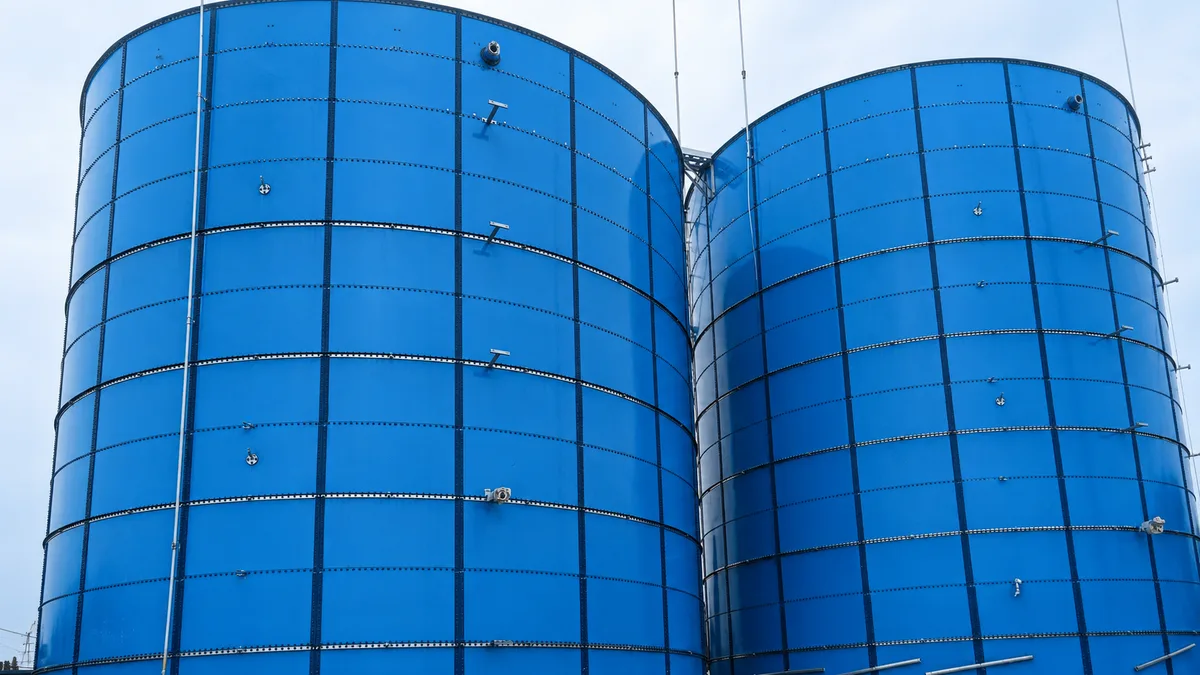
Industrial tank RFQ checklist for process duty, capacity, site loads, corrosion, roof and accessories, inspection, documentation, and delivery scope.
A complete RFQ gives each supplier the same operating, mechanical, site, inspection, and delivery basis for a comparable proposal.
The purpose of an RFQ is to expose assumptions before purchase order
A useful tank RFQ is a technical package, not only a request for a price. It gives the supplier enough process, mechanical, civil, environmental, quality, and delivery information to state a realistic scope, identify assumptions, and flag missing data. This makes quotes comparable and reduces rework after award.
Stored medium, tank function, gross and usable volume, tank count, future expansion, fill and withdrawal rates, minimum level, and operating cycle.
Chemical and thermal data
pH, chlorides, solids, density, viscosity, hydrocarbons, additives, temperature range, cleaning chemicals, and normal or upset conditions.
Mechanical scope
Tank type, diameter or height limits, roof, vents, nozzles, drains, overflow, access, mixers, insulation, instruments, and external equipment loads.
Site and civil data
Location, wind, snow, seismic basis, temperature, corrosive environment, foundation interface, containment, access, lifting, and delivery constraints.
Quality and commercial basis
Named standards and edition, inspections, records, testing, installation responsibility, documentation, schedule, packing, and warranty boundary.
Identify the actual storage duty first
The first page of an RFQ should state what the tank does in the process: raw-water receiving, potable-water reserve, wastewater equalization, fire reserve, chemical storage, sludge holding, bulk material storage, or gas buffering. The function determines the questions that follow and helps prevent an ordinary water-tank specification from being applied to a more demanding duty.
Capacity should distinguish nominal volume from usable operating volume. Minimum suction level, freeboard, dead volume, surge allowance, process reserve, future expansion, and any shared service must be defined. If the water balance or process calculation is still incomplete, mark the values as preliminary and ask suppliers to show the effect of their assumptions.
Give corrosion and material review usable data
Liquid description should cover ranges rather than a single ideal condition. pH, chlorides, hydrocarbons, solids, temperature, density, viscosity, cleaning chemicals, treatment chemicals, and contamination risks can affect material and coating choice. Include the safety data sheet or laboratory data when available, along with known changes during startup, upset, or seasonal operation.
The RFQ should also specify the external environment: coastal air, industrial fallout, UV exposure, condensation, freeze risk, or enclosed corrosive atmosphere. This allows suppliers to address both the wetted surface and the outside of the system, including roof, fasteners, nozzles, platforms, and repair provisions.
Show interfaces instead of leaving them as site assumptions
Provide a preliminary drawing, nozzle schedule, process flow diagram, or marked-up sketch. Include pipe loads, mixers, heating coils, roof-mounted equipment, ladders, platforms, instruments, vents, overflow, drains, containment, and available access. Even early information is better than a hidden interface that becomes a change order after fabrication.
Foundation, anchoring, drainage, settlement, lifting access, delivery route, container limits, and work restrictions should be visible. For retrofit projects, provide verified existing dimensions, photos, connection locations, and operational constraints. A new roof or tank cannot be engineered reliably from an assumed existing rim or nozzle position.
Request comparable quality and handover commitments
State the governing project documents by title and edition, then identify any owner or authority requirements. Avoid general wording such as globally compliant or approved everywhere. Destination-country requirements, owner standards, and responsible-engineer decisions remain project specific and should be confirmed through the appropriate approval process.
Ask every bidder to list drawings, calculations where included, material or coating records, inspection and test plan, repair procedure, packing list, installation support, manuals, spare parts, exclusions, and warranty scope. Quotes that do not use the same documentation and inspection basis are not directly comparable, even when their nominal tank sizes match.
RFQ and Next Steps
Send the duty, capacity basis, chemistry and temperature range, design documents, site loads, accessories, civil and installation interfaces, inspection requirements, delivery constraints, and required records. Clearly label unknowns so suppliers can state assumptions instead of guessing.