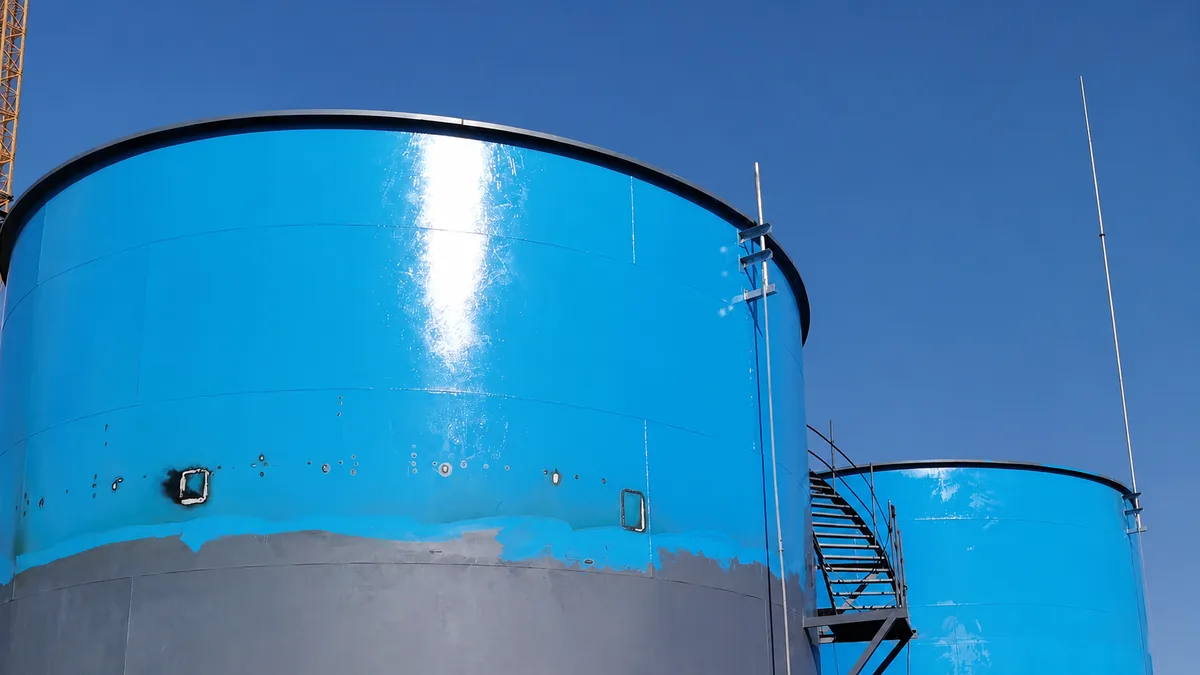
Industrial storage tank guide for process water, chemical liquids, factory utilities, slurry, material selection, accessories, containment, and RFQ data.
Industrial storage tank selection begins with the stored medium, operating envelope, process interfaces, and site responsibility split.
Classify the storage duty before selecting a tank
Industrial storage is not a single tank duty. The same factory may need raw-water tanks, treated-water tanks, process-water buffers, cooling-water storage, chemical day tanks, slurry tanks, wastewater equalization, fire reserve, lubricant storage, or emergency containment. Capacity alone cannot determine the material, coating, roof, nozzle arrangement, inspection scope, or construction method.
The first engineering task is to identify the stored medium and its complete operating envelope. Buyers should provide composition, concentration, density, viscosity where relevant, pH range, chloride or other corrosive constituents, solids, operating and cleaning temperature, filling and withdrawal rates, and any mixing, aeration, heating, or recirculation. Unknown values should be labeled as assumptions instead of being hidden inside a generic request for quotation.
Exact liquid or slurry name, composition, concentration, density, pH, chlorides, solids, contamination limits, and a current safety or product data sheet where applicable.
Operating envelope
Normal and maximum level, temperature range, fill and withdrawal rates, batch cycle, agitation, aeration, heating, cleaning, and upset conditions.
Tank construction
Bolted or welded format, carbon or stainless steel, coating or lining, corrosion allowance, gasket compatibility, and field installation constraints.
Process interfaces
Nozzle schedule, mixer or aeration loads, overflow, drain, venting, instruments, sampling, access, platforms, and upstream or downstream equipment.
Site and scope
Wind, seismic and snow data, geotechnical basis, foundation responsibility, containment, unloading access, erection scope, utilities, inspection, and handover documents.
Match construction to medium and project constraints
Factory-coated bolted tanks can suit process water, wastewater, utility water, and selected chemical duties when the coating and gasket system are compatible with the medium. Modular panels support containerized transport and site assembly, which can be valuable where access, lifting capacity, or construction schedule limits field fabrication. The proposal should identify coating system, panel edges, fasteners, gasket material, repair method, inspection records, and the installation quality plan.
Field-welded carbon steel tanks are often considered for large atmospheric storage, heavy industrial service, or projects governed by a welded-tank standard. Their suitability depends on corrosion allowance, internal coating or lining, weld procedure and inspection, bottom and roof design, site welding conditions, and the owner document package. Stainless steel can be justified by corrosion resistance, cleanliness, contamination control, or lifecycle cost, but grade selection and fabrication quality still require a medium-specific review.
Separate water, chemicals, slurry, and wastewater duties
Raw and treated water tanks should be assessed for water chemistry, turnover, biological growth, disinfection exposure, vent screening, overflow protection, sediment, and inspection access. A process-water tank may also need stable pump suction, level control, recirculation, or reserve capacity during upstream interruptions. If the duty is potable water or fire reserve, the applicable approval and life-safety requirements should be handled on the dedicated application page rather than assumed from an industrial-water quotation.
Chemical and slurry duties require more data. Chemical compatibility should consider concentration, impurities, temperature, cleaning chemicals, possible dilution heat, vapor, and gasket exposure. Slurry storage adds solids concentration, particle size and abrasiveness, settling rate, mixer duty, withdrawal geometry, and cleanout. Wastewater storage adds variable chemistry, odor, foam, gas potential, solids, and downstream process requirements. These services should not share one unqualified material recommendation.
Define roof, venting, accessories, and containment
Roof and vent selection follows the stored medium and operating mode. Water service may need a fixed cover, screened vents, access hatches, overflow, and protection from debris or sunlight. Wastewater may require odor extraction, foam allowance, corrosion-resistant roof components, or a gas-management interface. Volatile, heated, hazardous, or reactive liquids require project-specific venting and safety review by the responsible engineering team; an ordinary water-tank vent arrangement is not a substitute.
Accessories should be included before structural review. Mixers, pipe reactions, roof-mounted equipment, platforms, ladders, davits, level instruments, sampling systems, insulation, heating coils, and large nozzles can affect local loads and maintenance access. Secondary containment, leak detection, transfer-area drainage, and emergency response are normally coordinated with the site civil, process, environmental, and safety design. The quotation should state which interfaces are supplied and which remain by others.
Plan installation, inspection, and lifecycle records
A technically suitable tank can still fail as a project if the site is not ready. The RFQ should identify access road and container limits, unloading equipment, laydown area, crane or jacking plan, foundation tolerances, anchor details, power and water availability, weather constraints, permits, and responsibility for supervision. For operating plants, buyers should also describe shutdown windows, work-area segregation, hot-work restrictions, and tie-in sequencing.
The document package should match the project stage and risk. Typical requirements may include design calculations or summaries, approved drawings, material certificates, coating or lining records, weld and nondestructive examination records where applicable, dimensional checks, installation inspection forms, test procedure, repair records, operation and maintenance information, and spare-parts recommendations. The owner should define an inspection plan that reflects actual chemistry, cycling, abrasion, external environment, and consequences of leakage rather than relying on a generic service-life claim.
Prepare an RFQ that supports comparable bids
Comparable bids require a common design basis. State gross and usable capacity, dimensional constraints, stored-medium data, operating envelope, governing design documents, design loads, roof, nozzles, accessories, coating or lining, inspection, foundation and installation scope, delivery location, and required records. List exclusions and owner-supplied data explicitly so each bidder prices the same boundary.
Where chemistry or process data is incomplete, request a budget proposal with named assumptions and hold points. Final material selection should wait until the owner or process designer confirms the medium, cleaning regime, temperatures, and regulatory path. This staged approach gives the steel tank supplier enough information to recommend a practical construction route without presenting preliminary assumptions as final engineering.
Standards and Reference Notes
Industrial storage requirements depend on the jurisdiction, stored medium, owner specification, and project risk. A named industry standard can structure design and inspection, but it does not replace chemical compatibility review, local environmental and safety obligations, or the responsibilities assigned in the contract.
Next RFQ Steps
Send stored-medium data, gross and usable capacity, operating temperature and cycle, design loads, tank construction preference, roof, nozzles, accessories, coating or lining, containment, inspection, site constraints, and installation responsibility.