Chemical storage tank guide covering medium data, compatibility, venting, containment, materials, inspection, scope, and RFQ preparation.
Chemical tank selection begins with verified medium data and a compatibility review across every wetted component and operating condition.
Define the chemical and operating envelope before the tank
Chemical processing storage can include raw materials, intermediates, finished products, reagents, acids, alkalis, solvents, brines, additives, cleaning solutions, recovered liquids, and wastewater concentrates. A generic chemical tank request is not enough for responsible material selection. The buyer or process licensor should identify the exact substance or mixture, concentration range, impurities, density, viscosity, solids, normal and upset temperature, vapor behavior, filling and withdrawal rates, and cleaning method.
Tank construction may include lined or coated carbon steel, stainless steel, glass-fused-to-steel, fusion bonded epoxy, welded steel, or another engineered system. Compatibility must cover the shell, coating or lining, gaskets, sealants, bolts, nozzles, pipes, instruments, mixers, and any heating equipment. A suitable shell with an incompatible gasket or nozzle lining is still an unsuitable storage system.
Chemical or mixture name, CAS number where relevant, concentration range, impurities, density, viscosity, solids, vapor data, and current safety data sheet.
Operating envelope
Normal, minimum and maximum temperature and level, pressure or vacuum, fill and withdrawal rates, batch cycle, agitation, heating, dilution, cleaning, and upset conditions.
Wetted materials
Shell, coating or lining, gaskets, sealants, bolts, nozzles, pipework, instruments, mixers, heating elements, and compatibility evidence for the full service envelope.
Process safeguards
Normal and emergency venting, blanketing, vapor treatment, overflow, level alarms, overfill prevention, drainage, secondary containment, hazardous-area interfaces, and emergency response.
Project delivery
Governing documents, design responsibility, site loads, foundation, access, installation, inspection, testing, material traceability, commissioning boundary, and handover records.
Use verified process data for compatibility review
Compatibility tables and safety data sheets are screening tools, not final tank approvals. The same chemical name can represent different concentrations, contaminants, water content, inhibitors, or temperatures. Dilution, neutralization, batch mixing, clean-in-place chemicals, steam cleaning, and off-spec material can create a more severe condition than normal storage. The process owner should identify credible ranges and upset cases before the supplier confirms a material system.
The review must include every wetted component. Coatings can fail at cut edges, nozzles, bolts, repairs, liquid-vapor interfaces, or areas exposed during cleaning even when broad shell surfaces remain intact. Elastomers may swell, harden, permeate, or lose strength. Stainless grades can be vulnerable to pitting, crevice corrosion, stress corrosion, or contamination under specific chloride, temperature, and fabrication conditions. The proposal should state the service envelope and any exclusions clearly.
Separate atmospheric storage from pressure-vessel duty
A storage tank should not be assumed to resist pressure or vacuum unless that condition is part of its design basis. Rapid filling or withdrawal, blocked vents, thermal breathing, vapor generation, condensation, nitrogen blanketing, steam-out, pump-out, fire exposure, or connected process equipment can impose loads beyond normal atmospheric service. The responsible process engineer should define normal and emergency venting and any pressure or vacuum range.
If the required pressure exceeds the selected atmospheric-tank standard or construction system, the equipment should be routed to an appropriate pressure-vessel design rather than strengthened informally. Vent, relief, flame-control, vapor-recovery, scrubber, inerting, and hazardous-area requirements depend on the medium and jurisdiction. Their sizing and safety validation remain with qualified process and safety specialists unless the contract explicitly assigns that engineering scope to the tank supplier.
Coordinate mixing, heating, nozzles, and structural loads
Mixers, recirculation jets, coils, external heat exchangers, insulation, platforms, davits, large nozzles, pipe supports, and roof-mounted equipment can govern local structural design. The RFQ should provide equipment weights, operating and upset loads, torque, thrust, vibration, nozzle reactions, support points, maintenance removal paths, and whether loads are applied to the shell, roof, foundation, or an independent structure.
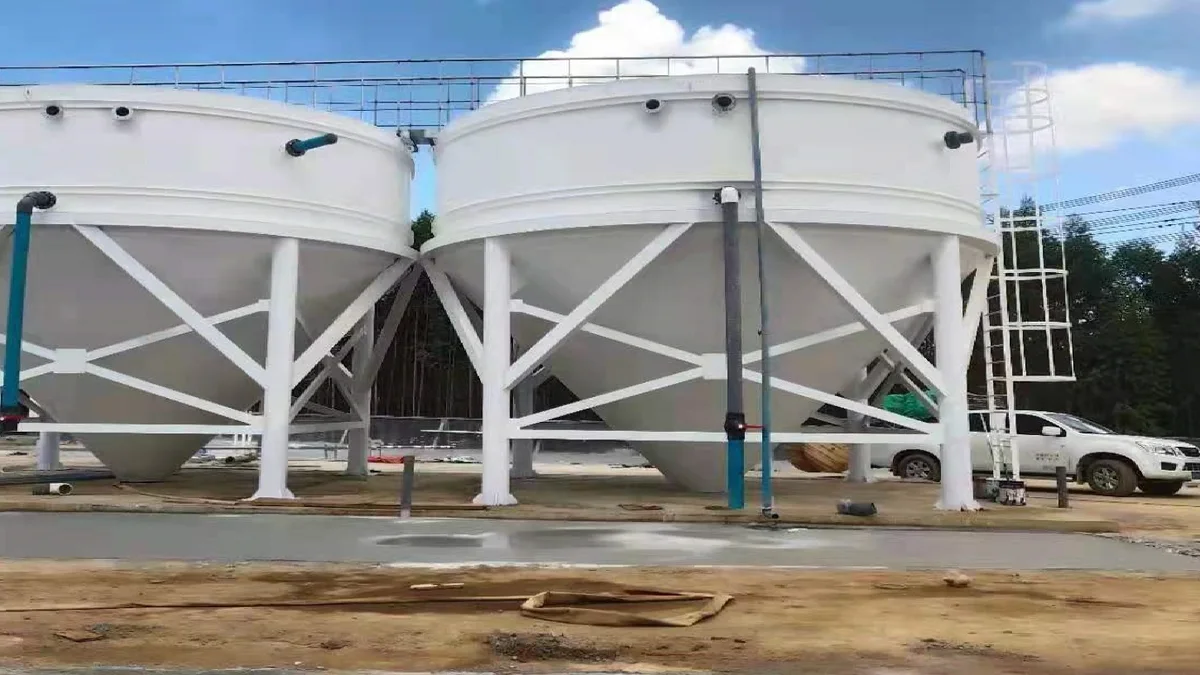
Drainability and cleanout should suit the medium. Cone or sloped bottoms may assist selected processes, but they change support and fabrication requirements. Crystallizing, settling, viscous, or solids-bearing liquids may need agitation, flush connections, larger drains, heating, or dedicated cleanout access. These choices should follow process behavior and maintenance strategy rather than a generic tank drawing.
Design containment and site interfaces as a system
Secondary containment volume, floor and wall compatibility, joints, penetrations, rainwater management, leak detection, transfer-area drainage, and emergency isolation are normally coordinated by the site civil, environmental, process, and safety teams. The tank proposal should define bottom interface, anchors, nozzle locations, allowable settlement, and any liner or leak-detection connection so the surrounding containment can be designed coherently.
Site data also includes wind, seismic, snow, ambient temperature, solar exposure, flooding, groundwater, soil or geotechnical basis, access roads, lifting limits, work permits, hazardous-area classification, grounding and bonding, and operating-plant restrictions. For export projects, packing, container limits, coating protection, repair kits, installation supervision, and document language should be agreed before shipment.
Specify inspection, records, and lifecycle controls
The inspection plan should reflect construction and consequence of leakage. It may include approved drawings, design review, material certificates, positive material identification where specified, welding procedure and welder records, nondestructive examination, coating thickness or continuity testing, lining cure records, dimensional inspection, nozzle checks, foundation acceptance, erection records, leak or hydrostatic testing, repairs, and final as-built documents.
Commissioning and operation should preserve the stated service envelope. The owner should control chemical substitutions, concentration and temperature changes, cleaning chemicals, vent condition, overfill protection, corrosion monitoring, coating repairs, gasket replacement, settlement, and inspection intervals. Any process change should trigger a compatibility review rather than relying on the original tank description.
Prepare a chemical storage RFQ that can be engineered
A complete RFQ should include the medium data sheet and safety data sheet, credible normal and upset conditions, gross and usable volume, tank geometry constraints, pressure and vacuum basis, fill and withdrawal rates, venting, blanketing, vapor control, mixer and heating loads, nozzles, access, material preferences, containment interface, site loads, installation responsibility, inspection, and required records.
Where data is incomplete, request a budget proposal with written assumptions and hold points rather than a final compatibility guarantee. The selected industrial tank manufacturer should explain the proposed material system, evidence basis, exclusions, inspection method, field repair approach, and scope boundary so the buyer can compare technically equivalent bids.
Standards and Reference Notes
The United Nations Economic Commission for Europe publishes the Globally Harmonized System of Classification and Labelling of Chemicals, Revision 11 as an international hazard-classification and communication framework. GHS information supports hazard review and safety data sheets, but it does not prove tank-material compatibility or replace the laws through which each country implements it. The destination jurisdiction, process owner, and responsible engineers must define the controlling requirements.
Next RFQ Steps
Send exact medium and concentration, impurities, temperature and pressure range, density and viscosity, safety data sheet, fill and withdrawal rates, venting, mixing and heating, wetted materials, containment, site loads, inspection, and installation scope.