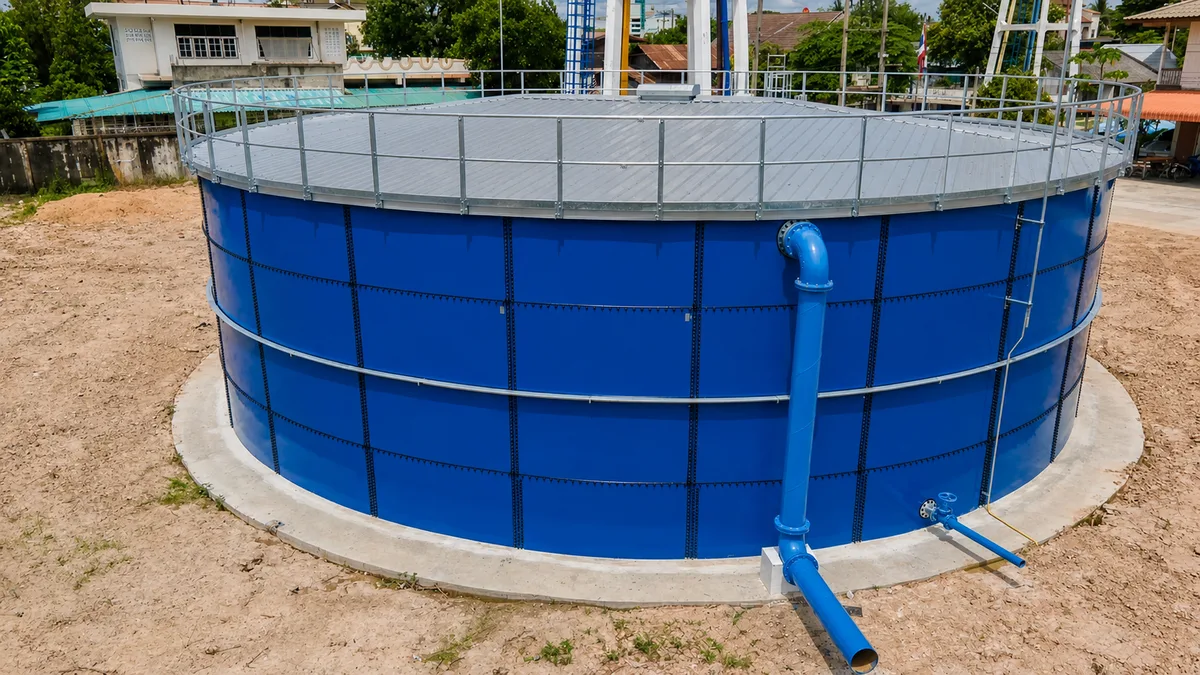
Seawater desalination tank solution page for high-chloride water storage, stainless steel tanks, epoxy tanks, dome roofs, and corrosion review.
Desalination tank projects should separate raw seawater, permeate, brine, CIP, and process water duties before selecting material.
Seawater Desalination Storage Solutions
Desalination plants may require storage for raw seawater, filtered feed water, permeate, backwash water, CIP chemicals, neutralization liquids, brine, and product water. These duties have different corrosion, hygiene, and maintenance requirements, so one generic tank specification is not enough.
High-chloride exposure makes material and coating review critical. Buyers may compare stainless steel bolted tanks, epoxy coated tanks, GFS tanks, welded tanks, and aluminum dome roofs depending on stored medium, temperature, cleaning chemicals, and local approval requirements.
The RFQ should include water analysis or at least chloride range, pH, operating temperature, tank duty, cleaning method, and whether the tank is for feed, permeate, or brine. Without this data, supplier comparisons become unreliable.
Desalination RFQ Data
Review Area
Buyer Data to Provide
Process position
Raw seawater, pretreated feed, permeate, backwash, CIP, neutralization, brine, or product water.
Stainless steel can be appropriate for selected desalination duties, but grade and finish still need review. Epoxy or GFS systems may fit other positions when chemistry and lifecycle cost support them.
Use the specification points above to compare tank options, clarify project requirements, and prepare a more accurate RFQ before discussing final pricing.
For a quotation, confirm the stored media, required capacity, project location, design or document requirements, roof and accessory scope, inspection needs, and installation responsibility.
Procurement Scope and Handover Notes
Seawater Desalination Storage Solutions should be reviewed as part of a complete storage system. Before final pricing, the buyer should confirm whether the supplier scope includes engineering drawings, material or coating records, roof and accessory supply, packing protection, installation documents, and commissioning support.
For international RFQs, the same tank volume can lead to different quotations if site loads, corrosion data, inspection requirements, approval standards, or installation responsibility are missing. A stronger inquiry clearly separates confirmed data from assumptions so the supplier can respond with a comparable technical proposal.
Next RFQ Steps
Send process duty, water analysis, chloride range, pH, temperature, volume, roof/accessories, site country, standard preference, and inspection documents required.
A desalination facility can require seawater intake buffer, pretreated feed, backwash water, chemical solution, permeate, remineralized product water, brine, sludge, and cleaning-waste storage. Chloride exposure, solids, pH, disinfectants, cleaning chemicals, temperature, and hygiene requirements vary across these duties, so one material decision should not be copied across the entire plant.
The RFQ should identify whether the tank receives raw seawater, filtered feed, reverse-osmosis permeate, conditioned drinking water, concentrated brine, or intermittent cleaning solution. That process location governs compatibility review, roof and vent design, access, drainage, instrumentation, and approval documents.
Treat chloride and external marine exposure separately
Internal chloride concentration is only one corrosion input. Temperature, dissolved oxygen, pH, concentration cycles, chemical cleaning, stagnation, crevices, dissimilar materials, and gas-space condensation may alter risk. The proposed coating or material system should state its service basis and exclusions using the project’s actual chemistry range.
Coastal air can also attack external fasteners, platforms, roof components, instruments, pipe supports, and damaged coating areas. Buyers should request an external corrosion strategy, handling and repair procedure, inspection access, and maintenance guidance rather than assuming that an internally suitable tank is automatically protected outside.
Protect product-water quality and hydraulic reliability
Permeate or finished-water tanks may need water-contact documentation, protected vents and overflows, hygienic access, disinfection interfaces, sampling, sunlight control, and cleaning provisions defined by the owner and destination approval route. Product approval and complete project approval should be treated as separate questions.
Usable storage should follow the plant water balance, train availability, downstream demand, refill rate, minimum operating level, and emergency strategy. Large transfer nozzles, pump suction, overflow routing, and pipe reactions must be coordinated with civil and mechanical design before tank drawings are released.
Separate seawater, brine, and cleaning-waste duties
A desalination facility does not have one universal storage duty. Raw seawater, screened or filtered feed, intermediate process water, desalinated product water, concentrated brine, sludge, and cleaning or flushing waste can have materially different chemistry, solids loading, temperature, flow pattern, and containment implications. The RFQ should identify the process location of each tank instead of calling all of them desalination water tanks.
The data should state whether the tank normally sees continuous flow, intermittent storage, recirculation, stagnant reserve volume, cleaning chemicals, or a blend created during upset conditions. External marine atmosphere and splash exposure should be recorded separately from the internal liquid. This gives the engineering review a defined exposure envelope and prevents a coating, lining, metallic material, gasket, or roof decision from being carried over from one duty to another without a compatibility review.
Use the corrosion protection guide with the project chemistry record to document assumptions, vulnerable details, inspection access, and the approved repair route for the actual service.
Design for service continuity as well as material compatibility
Material suitability is only one part of an operable desalination storage package. Buyers should define required reserve time, process-train arrangement, pump suction conditions, isolation and bypass needs, overflow and drain routing, access for cleaning and inspection, roof penetrations, instrumentation interfaces, and the sequence for commissioning or flushing. These decisions can affect tank sizing, nozzle locations, roof configuration, structural loads, and the scope of civil, piping, electrical, and process contractors.
For product-water storage, the owner should also state the intended use, destination approval route, cleaning requirements, and who is responsible for system hygiene after installation. A tank supplier can describe the proposed equipment boundary, but final water-system compliance and operating procedures remain project-specific responsibilities. The drinking water storage page helps separate product-water requirements from raw-water and concentrate duties.
Before comparing proposals, build the tank-by-tank duty table in the RFQ data checklist and ask each bidder to identify confirmed inputs, open assumptions, supplied accessories, and exclusions.