
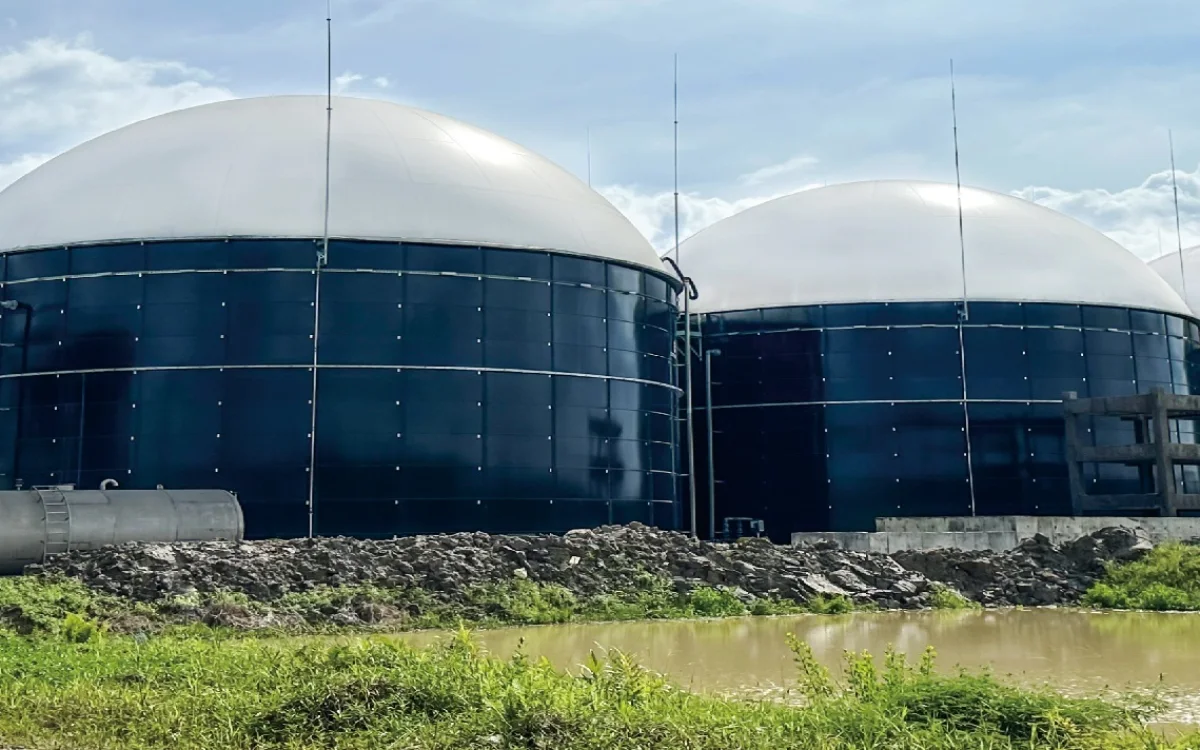
Livestock manure treatment projects are usually driven by two requirements at the same time: wastewater stabilization and renewable gas recovery. A membrane gas holder is used when the anaerobic system needs a flexible buffer between uneven biogas production and downstream use such as a boiler, flare, or generator.
This type of project should be reviewed together with biogas and anaerobic digestion requirements rather than treated as a simple storage cover. Farm wastewater can contain suspended solids, ammonia, sulfide, odor compounds, and variable organic loading, so the gas holder, tank roof, nozzles, and safety accessories must match the operating duty.
Why the Project Needs a Gas Holder
Manure treatment systems rarely produce gas at a perfectly constant rate. Feeding cycles, temperature, retention time, digestion stability, and seasonal farm operation can change the gas curve. The gas holder helps stabilize pressure and provides short-term storage so the energy-use equipment is not forced to respond to every process fluctuation.
For procurement, the buyer should confirm expected daily gas production, minimum and maximum operating pressure, methane content, H2S level, condensate load, gas temperature, emergency venting, and whether the system connects to a flare, combined heat and power unit, boiler, or upgrading equipment.
Tank and Interface Review
The gas holder should be reviewed with the liquid-side tank system. Where a project uses an anaerobic digester tank, the interface between liquid containment, membrane roof, gas pipework, access points, and maintenance platforms should be defined before fabrication. If the tank is bolted, the panel coating, sealant, roof ring, and gas-tight connections need documented inspection.
Hydrogen sulfide and moisture are the main gas-side issues. H2S can accelerate corrosion in poorly protected components, while condensate can create low-point blockage if the piping slope and drain points are not planned. Buyers should ask for material compatibility, membrane specification, anchoring method, pressure protection, and inspection access.
RFQ Data to Prepare
A qualified RFQ should include wastewater source, animal type, daily manure or wastewater volume, digester type, expected biogas flow, methane content, H2S range if available, pressure requirement, local wind data, gas utilization method, and installation boundary. The RFQ data checklist can be used to organize these inputs before requesting a quotation.
For future project comparison, this page should connect to related references such as biogas project cases and product pages such as biogas storage tanks. That keeps the page useful for buyers researching farm-scale and industrial-scale biogas storage systems.
Procurement Notes
For farm projects, installation practicality is often as important as the equipment specification. The buyer should confirm road access, crane access, foundation readiness, weather window, local labor availability, and whether the supplier provides assembly drawings or site supervision. These details affect total installed cost more than the membrane price alone.
Because manure wastewater conditions can change during farm expansion or seasonal operation, it is also useful to define a design margin for gas flow and pressure control. The quotation should state what is included in the gas holder package, what belongs to the EPC contractor, and which instruments or safety devices are supplied by others.