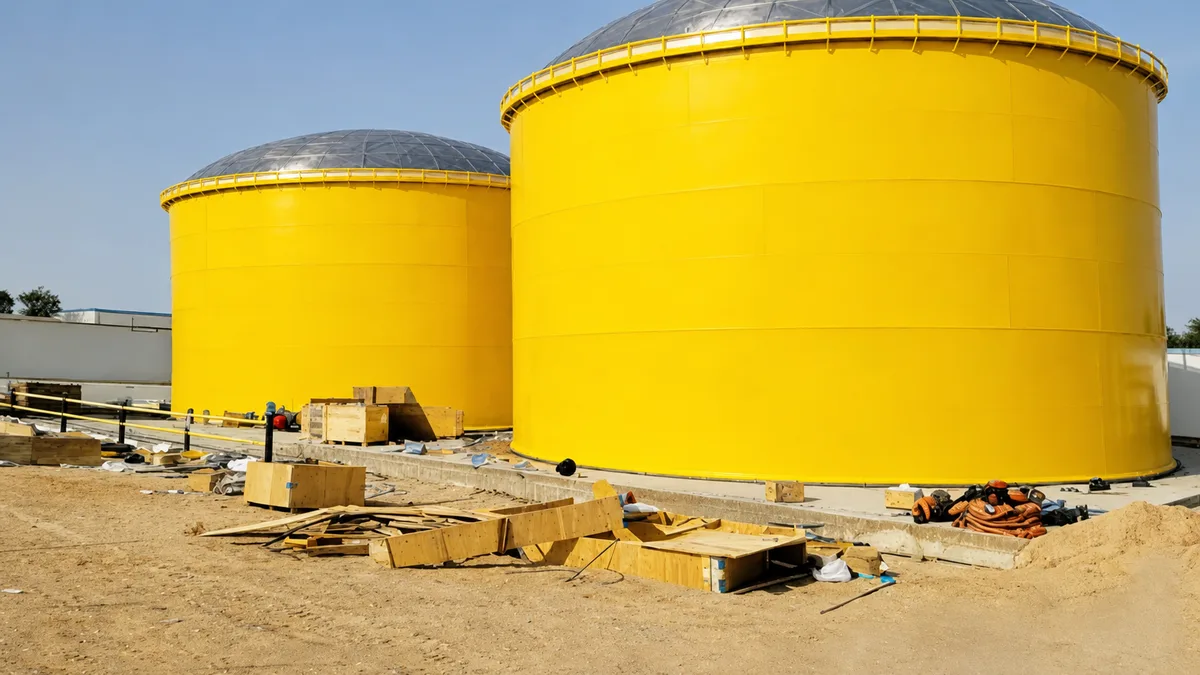
An internal floating roof must be reviewed together with the fixed roof, vapor space, liquid duty, seals, supports, drainage, access, inspection, and the adopted design basis.
An Internal Floating Roof Is a System Interface
An internal floating roof is installed within a fixed-roof storage tank to support an owner-defined liquid-storage and vapor-management duty. Its suitability depends on the stored liquid, tank geometry, fixed-roof arrangement, operating levels, vapor-space environment, seals, supports, deck configuration, drains, access, instrumentation, inspection plan, and the specific standard or owner specification adopted for the project. It should not be selected from a generic product name or a requirement for a floating roof alone.
For related equipment context, see the floating roofs product page and the petrochemical and oil storage application page. This resource helps buyers define the questions required for engineering review; it does not substitute for the governing code, project hazard review, or local approvals.
Internal Floating Roof Review Matrix
Review area
Information to establish
Stored liquid
Composition, temperature, density, vapor behavior, contaminants, additive or cleaning exposure, normal and upset conditions, and owner-approved compatibility basis.
Tank interface
Fixed roof, shell, columns or supports, nozzles, vents, roof penetrations, level range, freeboard, drainage, emergency overflow, and attached equipment.
Roof assembly
Deck construction, rim and seals, buoyancy basis, supports, legs, rolling ladder or access, gauge wells, anti-rotation, inspection, maintenance, and repair route.
Design basis
Applicable standard or owner specification, loads, pressure and vacuum cases, inspection plan, documents, site installation, tests, and acceptance criteria.
Confirm the Fixed-Roof Tank and Liquid Duty First
An internal floating roof is not an independent tank. The proposal must identify the fixed-roof tank geometry and condition, shell and roof details, columns or internal supports, nozzle locations, vents, gauge wells, operating levels, and attachments. The stored liquid and vapor-space conditions should be documented with temperature and relevant contamination or cleaning exposure. A roof arrangement suitable for one service should not be transferred to another without review.
The adopted design basis should be named by the owner. API 650 and other standards may be relevant only where their scope and edition are adopted for the actual project; they are not universal approval statements. The responsible engineer should confirm the governing requirements, local rules, and any additional owner specifications before procurement.
Specify Seals, Supports, Drainage, and Access
Deck, rim, seal, support, anti-rotation, access, gauge-well, and drain details affect operation and inspection. The RFQ should identify the expected liquid level range, roof movement, support landing conditions, maintenance access, seal replacement route, roof loading, drains, and the control of liquid or condensate at low points. A request for emission control should be translated into measurable project requirements and acceptance responsibilities rather than an unqualified promise.
Access must be planned for inspection, maintenance, isolated work, and emergency response. Identify ladders, platforms, fall protection, lifting provisions, roof penetrations, temporary works, lighting, instrumentation, and restrictions on later attachments. These interfaces affect the tank roof and site layout as well as the floating-roof package.
Connect Inspection to the Contract
The contract should identify drawings, calculations where included, material and coating records where applicable, assembly instructions, inspection points, repair procedures, transport and handling requirements, site installation boundary, test requirements, and closeout documents. Acceptance criteria belong in the project documents; they should not be inferred from a photograph or a generic manufacturer statement.
Compare the roof function with fixed, external floating, dome, and membrane alternatives, then use the RFQ data checklist to issue one coordinated enquiry. The comparison must identify what the roof is expected to control, how that result will be measured, and which party is responsible for the equipment outside the roof package.
Review Movement, Clearances, and Operating Levels
The engineering package should state the highest and lowest operating levels, liquid drawdown rate, roof landing condition, minimum clearance to roof members and attachments, and the relation between buoyancy, support, and access components. Existing tanks require verified as-built measurements rather than a drawing-only assumption. Shell shape, internal columns, ladder locations, gauge wells, nozzles, roof supports, and corrosion condition can affect installation and later roof movement.
The roof should be assessed through normal operation, abnormal high or low levels, inspection, cleaning, repairs, and return to service. Where the tank is connected to a transfer system, instrumentation and operating procedures must prevent an unplanned condition outside the approved level or pressure range. Mechanical selection and operating safeguards should be coordinated instead of treated as separate procurement exercises. The commissioning plan should identify the observation points, records, and correction process used to confirm the installed roof moves without interference across its approved operating range.
Define Retrofit Boundaries Before Fabrication
For a retrofit, define tank cleaning and gas-freeing responsibility, confined-space controls, temporary ventilation and lighting, access opening size, lifting route, material storage, hot-work limits, field assembly, and disposal of removed components. These items can control project duration and cost more than the roof hardware itself. The survey record should identify uncertain dimensions and the process for resolving them before materials are released.
For a new tank, coordinate roof interfaces while the shell, fixed roof, nozzles, vents, instruments, and access system are still being designed. Early interface review reduces late changes, seal conflicts, and inaccessible inspection points. The final delivery plan should state who verifies site readiness, who records installation checks, and what documentation is needed before the tank returns to operation. It should also define preservation requirements when installation is delayed, including protection of seals, metal components, openings, and stored materials from site contamination or weather exposure.
Data to Include in the RFQ
An internal floating roof RFQ should establish the fixed-roof tank, liquid and vapor duty, roof assembly, access, inspection, and adopted design basis before bids are compared.
Existing or new tank geometry, fixed roof, columns or supports, nozzles, vents, gauge wells, access, drainage, instruments, attached loads, and required modifications.
Deck, seals, supports, access system, anti-rotation, buoyancy, maintenance route, inspection plan, repair procedure, and site installation boundary.
Adopted standard or owner specification, drawings, calculations where included, test requirements, documents, acceptance criteria, local approvals, and handover scope.