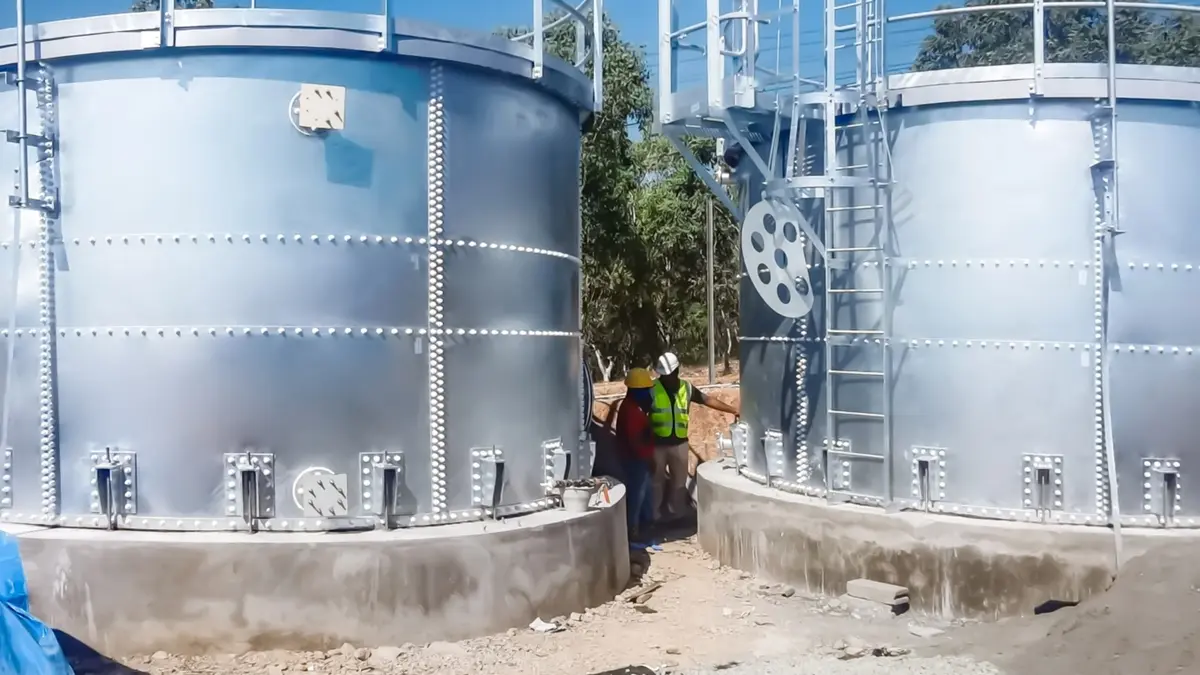
Agriculture water storage tank guide for irrigation buffers, farm and livestock water, coating selection, roof planning, site data, and RFQ preparation.
Agricultural water tanks should be specified around water quality, seasonal demand, site access, and coating durability rather than capacity alone.
Where agricultural tank selection usually goes wrong
Agriculture and irrigation projects often look simple at the quotation stage, but the tank duty can change quickly once the buyer confirms the water chemistry, drawdown cycle, filling method, installation location, and maintenance access. A farm water tank used as a daily irrigation buffer is not the same procurement problem as a poultry drinking water tank, a fertigation tank, or a process tank connected to agricultural wastewater or biogas pretreatment.
For an industrial tank manufacturer, the useful starting point is not only the nominal volume. Buyers should define whether the tank stores raw water, treated water, recycled water, stormwater, fertilizer solution, washdown water, or agricultural wastewater. That duty drives coating selection, roof type, nozzle layout, ladder and platform requirements, foundation planning, and whether a bolted or welded approach is the most practical for the site.
Raw water, treated water, recycled water, fertilizer solution, animal drinking water, washdown water, or agricultural wastewater must be separated because coating and hygiene expectations differ.
Capacity profile
Confirm usable volume, peak irrigation drawdown, refill rate, emergency reserve, and whether the tank must support daily cycling or seasonal storage.
Tank format
Bolted tanks suit remote sites and fast installation; welded tanks may be used where field welding, large shells, or a specific design standard is required.
Roof and cover
Open-top tanks may be unsuitable where debris, algae, odor, bird activity, or potable/livestock water quality matters; dome or fixed roofs can reduce contamination risk.
Site data
Wind, seismic, soil bearing, flood level, access road, lifting plan, foundation readiness, and unloading conditions should be confirmed before final pricing.
Recommended tank types for farm and irrigation duty
Glass-fused-to-steel tanks are commonly reviewed for farm water, irrigation buffer, and recycled water projects because the coating is applied in factory conditions and the tank can be assembled from modular panels at the site. This can be useful where the project location is remote, the buyer needs containerized delivery, or the tank must be expanded through a clear panel-based installation plan.
Fusion bonded epoxy tanks are another candidate when the stored water chemistry is moderate to aggressive and the buyer wants a factory-coated steel panel system. The quotation should identify coating thickness, holiday testing or inspection requirements, repair procedure, gasket compatibility, and whether the stored liquid includes fertilizer, organic load, or cleaning chemicals.
Galvanized steel tanks may fit selected irrigation or utility-water duties, but they should not be selected by price alone. Water chemistry, fertilizer exposure, coastal air, and maintenance expectation must be checked. For more aggressive applications, compare the galvanized option with epoxy coated steel, GFS, or stainless steel rather than treating all farm tanks as interchangeable.
Water quality and corrosion checks before quotation
Agricultural water may contain suspended solids, chlorides, fertilizer residues, biological load, or seasonal pH variation. These conditions influence coating choice and inspection scope. A useful RFQ should include pH, chloride level if available, expected temperature, any chemical dosing, and whether the tank will be cleaned manually, flushed, or connected to automated washdown equipment.
For livestock drinking water or food-related agricultural operations, hygiene and contamination control become more important. The buyer should confirm whether the tank needs a covered design, screened vents, overflow protection, access hatches, drainage points, and internal surfaces that can be inspected safely. If the water will later enter a food or beverage process, route the buyer to food and beverage processing tanks instead of using a generic irrigation specification.
Roof, nozzle, and accessory planning
Agriculture projects often under-specify accessories. Inlet turbulence, sediment settlement, overflow location, drain arrangement, pump suction height, anti-vortex needs, and level instrumentation can all affect operating reliability. A tank that is easy to quote but difficult to operate is a poor result for a high-value B2B buyer.
Roof selection should consider insects, birds, leaves, sunlight, odor, and whether the owner needs access for inspection or cleaning. Aluminum dome roofs can be considered for larger water tanks where corrosion resistance, lightweight installation, and low-maintenance cover performance matter. For wastewater or gas-generating agricultural duties, fixed water-tank roof assumptions may not be enough; review biogas and anaerobic digestion systems separately.
RFQ data that improves quotation accuracy
A high-quality RFQ should provide the tank capacity, preferred diameter and height if constrained, stored liquid, water chemistry, operating temperature, site location, design wind and seismic requirements, roof type, nozzle schedule, ladders and platforms, foundation responsibility, installation scope, and expected delivery route.
If some values are unknown, the buyer should identify the project stage. Budget quotation, tender support, and final engineering quotation are different levels of review. The more clearly the buyer separates known data from assumptions, the easier it is for a steel tank supplier to recommend a practical system without overpromising on a weak specification.
Standards and Reference Notes
The UN Food and Agriculture Organization describes water harvesting and storage as part of agricultural water management and resilience. It is planning guidance, not a tank design code; local water regulations, farm hygiene rules, structural requirements, and project owner standards still control the final specification.
Next RFQ Steps
Send stored liquid, water quality data, usable volume, refill and drawdown cycle, roof preference, nozzle schedule, site location, design loads, foundation status, and installation responsibility.