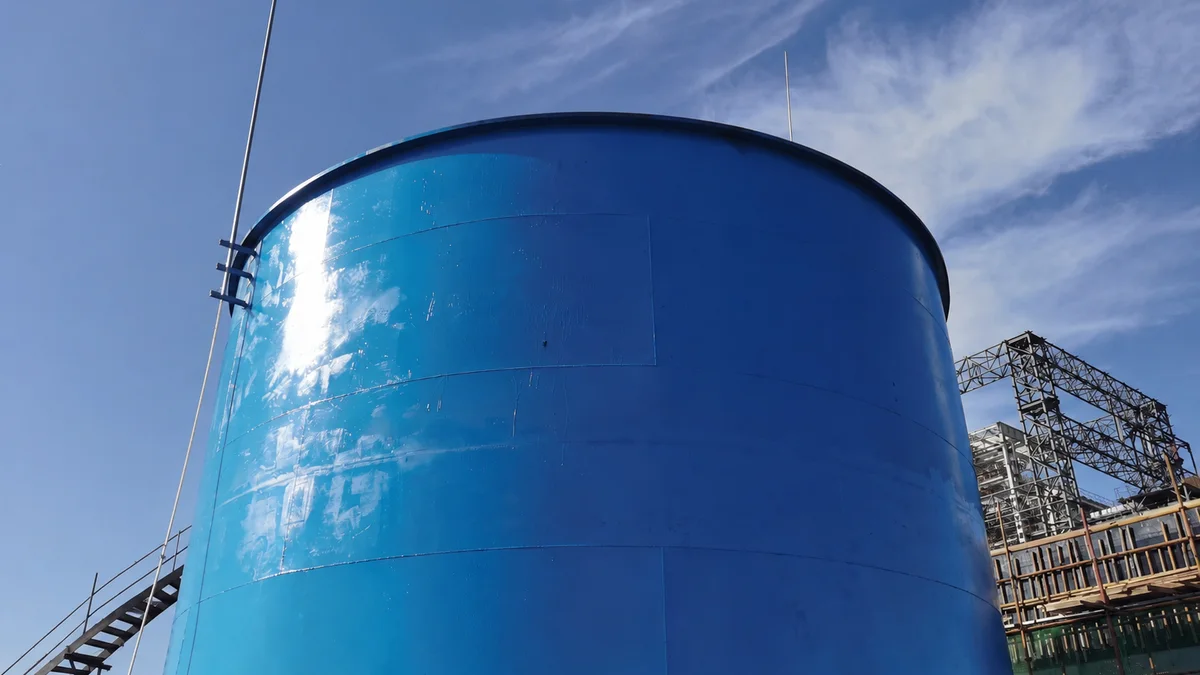
Plan stormwater storage tanks by runoff basis, detention or reuse duty, sediment, overflow, drawdown, roof and vent arrangements, site loads, and RFQ data.
Stormwater storage requires a defined hydraulic duty, sediment and overflow strategy, operating level range, and site interface before tank capacity is selected.
Start With the Water Balance and Site Drainage Plan
Stormwater tanks can provide detention, attenuation, temporary storage, rainwater harvesting, fire-water support, process-water supply, or controlled discharge. Those duties are not interchangeable. The required storage volume and tank arrangement depend on the approved runoff calculation, rainfall event basis, permitted discharge rate, catchment layout, upstream drainage controls, operating levels, and the destination of stored water. A tank should not be sized from roof area alone without the project drainage design.
The water quality entering a stormwater tank can vary with first-flush solids, sediment, debris, oils, chemicals, traffic areas, construction activity, or process runoff. The owner and civil designer should define what water may enter the tank, what treatment or separation occurs upstream, how sediment is removed, and whether stored water is suitable for reuse. Tank construction, roof, vents, access, and withdrawal points must follow that duty.
This page owns stormwater storage application logic. Use the welded steel tank page for a construction-system review; broader process-liquid or site-utility duties need their own application review.
Stormwater Storage Duty Matrix
Duty
Primary design questions
Detention or attenuation
Design event, allowable discharge, inlet/outlet control, operating levels, overflow routing, drawdown time, and authority requirements.
Rainwater reuse
Catchment quality, first-flush diversion, filtration, disinfection where required, reuse demand, turnover, and water-quality approval.
A stormwater tank cannot solve every drainage problem if clean roof runoff, vehicle-area runoff, process drainage, washdown, and spill-prone areas are mixed without a defined treatment path. The drainage plan should identify each contributing area, expected pollutants, shutoff or diversion points, and the operating response to an incident. That information affects whether the tank is a simple storage asset, part of a treatment train, or an emergency isolation facility.
Sediment and debris management must be practical. Inlets, baffles, low points, access openings, pump intakes, and cleaning routes should be arranged so operators can inspect and remove accumulated material. A nominally large tank loses useful volume when sediment management is ignored. The RFQ should state the expected solids, cleaning method, and whether the supplier provides internal features or only the tank shell interface.
Define Detention, Reuse, and Overflow Separately
Detention systems are controlled by a hydraulic release philosophy; reuse systems are controlled by water demand and quality; emergency storage is controlled by isolation and response time. These duties can share a physical tank only when the authority, operator, and process design accept the operating sequence. The project should state the normal water level, emergency level, low operating level, high-level alarm, overflow path, and the action required after each event.
The overflow route deserves the same review as the tank capacity. It must lead to an approved location and should not create erosion, flooding, cross-contamination, or an uncontrolled discharge. The designer should also define whether pumps, gravity discharge, throttling, valves, level controls, or an external treatment system determine drawdown. Tank suppliers need those interfaces to design nozzles, access, structural supports, and instrumentation scope.
State the design storm and local approval basis supplied by the civil or drainage engineer.
Identify sediment, oil, chemicals, debris, or other contaminants expected at each inlet.
Confirm the maximum water level, overflow route, drawdown method, and maintenance isolation plan.
Choose a Tank Package That Can Be Operated
Outdoor storage needs a roof or cover decision that considers rainfall, debris, evaporation, algae or contamination risk, venting, access, snow or wind where relevant, and the intended water quality. Open, fixed-roof, dome-roof, or other arrangements should be selected from the operating duty. A cover that keeps debris out may also change ventilation, access, inspection, or cleaning requirements.
Foundation, anchors, site drainage around the shell, access road, crane space, ladders, platforms, fall protection, electrical isolation, and remote level monitoring should be discussed before the tank layout is frozen. For roof alternatives, review the storage tank roofs guide. For installation responsibilities, use the installation guide as a preparation checklist.
Prepare a Comparable RFQ
The RFQ should separate capacity from usable operating volume and should identify the drainage duty, water quality, upstream treatment, downstream destination, and every accessory required for operation. It should also identify whether civil drainage works, pumps, controls, power, foundation, installation, testing, and commissioning are supplied by the tank contractor or by other parties.
Project teams should compare offers against the same water balance, design event, operating levels, scope boundaries, materials, roof, access, inspection, and document requirements. A tank proposal that only states diameter and height does not prove that the complete stormwater system can detain, release, clean, or reuse water as intended.
Data to Include in the RFQ
A stormwater storage RFQ should give the tank supplier a defined hydraulic duty, water-quality basis, operating levels, overflow route, site loads, and accessory scope.
Approved runoff calculation or design basis, contributing areas, design event, allowable discharge, required storage volume, and drawdown philosophy.
Expected water quality, sediment/debris/oil or chemical risk, upstream treatment, first-flush or isolation arrangement, and cleaning procedure.
Normal, low, high, emergency, and overflow levels; reuse demand or downstream destination; pumps, valves, controls, and power interfaces.
Tank geometry, roof or cover, vents, inlets/outlets, overflow, drain/sump, access, platforms, ladders, level instruments, and fall protection.
Project location, wind/seismic and ambient conditions, foundation, anchoring, site drainage, access, installation boundary, and local approvals.
Inspection, leak or hydrostatic test, handover documents, operation plan, cleaning access, spare parts, and commissioning requirements.