Home›Projects›Brunei Drinking Water FBE Tank Project
Brunei Drinking Water FBE Tank Project
Review a Brunei drinking water FBE bolted tank reference and the data needed for capacity, coating approval, roof, site loads, foundation, installation, and QA.
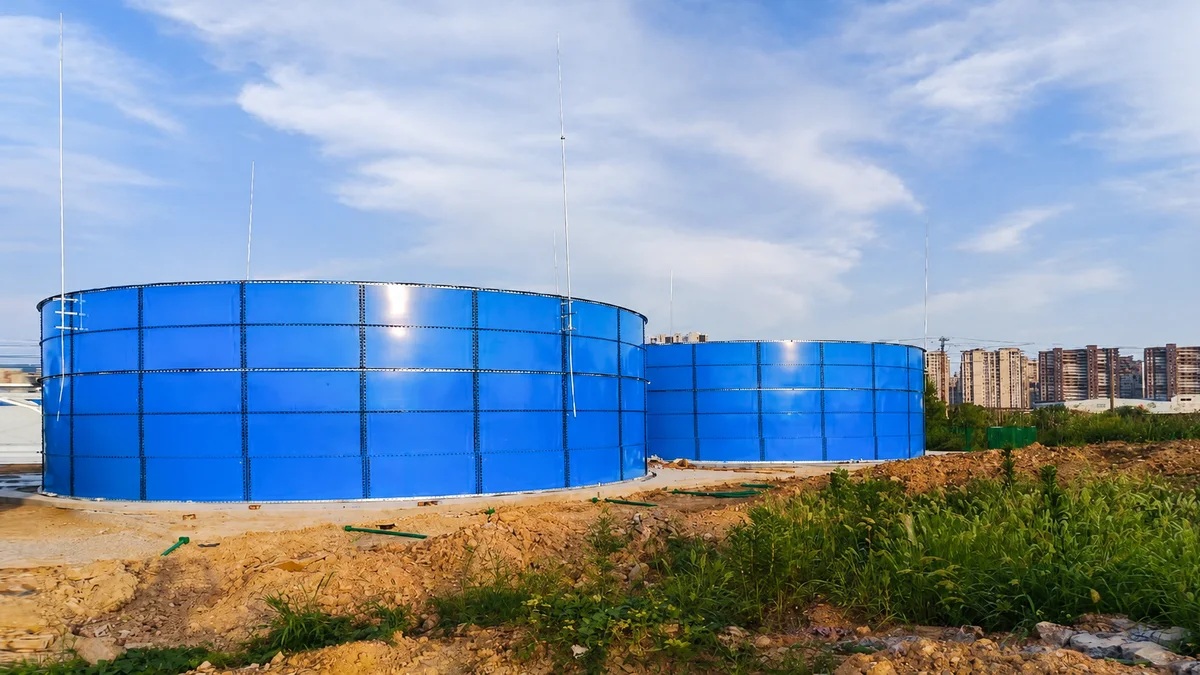
The source project presents two blue modular bolted tanks at installation stage; exact capacity and final accessory scope must be confirmed from project documents.
Project Context and Evidence Boundary
This reference is based on a source project identified as fusion bonded epoxy tanks for drinking water service in Brunei. The project image shows two blue bolted cylindrical tanks at an installation site. The publicly available source does not provide a complete approved data sheet, so this page does not invent tank capacity, diameter, water authority, commissioning date, design pressure, or final accessory schedule.
The useful lesson is the engineering path for a similar municipal or utility-water project. Potable service requires the buyer to identify the applicable drinking-water contact approval, owner specification, structural standard, local wind and seismic basis, hygiene controls, roof and vent protection, and commissioning procedure. A supplier certificate should be checked against the exact coating, sealant, gasket, and wetted components included in the quotation.
Brunei projects also require site planning for rainfall, drainage, construction access, panel protection, and foundation readiness. These are project execution considerations rather than universal design values. The engineer of record remains responsible for confirming local loads, geotechnical basis, foundation design, and authority acceptance.
Project Qualification Snapshot
Confirmed or required item
Review position
Application
Drinking water storage is identified by the source project; final water quality and disinfection regime remain buyer inputs.
Tank system
Blue modular bolted steel tanks with factory-applied FBE coating are shown; exact coating specification and approval documents require contract confirmation.
Capacity and geometry
Not stated in the public source. Similar projects must provide gross and usable volume, operating levels, diameter/height constraints, and future expansion.
Site and structure
Project-specific wind, seismic, rainwater drainage, soil/foundation conditions, anchorage, roof loads, and access must be supplied.
Handover
Drawings, material/coating records, inspection reports, installation records, leak or hydrostatic test, cleaning, disinfection, and commissioning documents should be agreed.
Potability Is a System Requirement
Potable-water compliance is not proven by the tank shell alone. The review should include internal coating, sealant, gaskets, bolts or caps exposed to water, roof drainage, vents and screens, overflow, access hatches, internal fittings, cleaning materials, and commissioning chemicals. Approval schemes vary by country and authority, so the contract should name the accepted certification path instead of assuming one document is global.
The corresponding application guidance is on the drinking water storage page. For the coating and modular panel system, review fusion bonded epoxy tanks without treating general product claims as project certification.
Foundation and Installation Control the Site Outcome
Before shipment, the project team should freeze the tank diameter, bottom and foundation interface, anchor arrangement, nozzle orientation, roof and access scope, unloading sequence, lifting or jacking method, and installation responsibility. Foundation tolerances, drainage and cured strength should be verified before panel assembly begins.
Coated panels need protected packing, controlled unloading, soft lifting contact, and repair procedures for any transport or erection damage. Sealant storage and application conditions, bolt tightening sequence, weather interruptions, and cleanliness controls should be recorded. The finished tank then proceeds through the contract test, cleaning, disinfection, and water-quality acceptance route.
Use This Case as Evidence, Not a Template Specification
A project photo proves that a tank configuration has been erected, but it does not disclose every design input. Buyers should use references to ask better questions: what was the usable volume, what approval was accepted, who designed the foundation, how were panels protected in transit, what installation supervision was provided, and what documents were handed over?
Compare this reference with other cases on the water storage project category, then issue one project-specific RFQ rather than copying a previous tank schedule.
Export Logistics Need a Site Storage Plan
Modular panels can simplify international shipment, but the packing plan still needs moisture protection, abrasion separation, lifting points, package identification, customs documents, and an unloading sequence that matches erection. Long storage at port or site can expose packages to rain, salt-laden air, ultraviolet light, mud, and repeated handling. The contractor should provide a protected laydown area and an incoming inspection before assembly.
Construction planning should also address drainage around the foundation, safe access during heavy rain, sealant storage limits, temporary stability, lightning and electrical safety, and cleanliness before closing the tank. Recording panel condition, repairs, bolt control and commissioning tests gives the owner a traceable handover package without claiming that one previous project specification fits every Brunei site.
Data to Include in the RFQ
For a drinking-water tank similar to this reference, provide enough data to verify potability, structure, coating, installation, and commissioning as one package.
Project country, owner and authority requirements, applicable tank standard, potable-water contact approval path, and required certificate language.
Gross and usable capacity, operating levels, diameter/height limits, inlet/outlet cycle, turnover, and future expansion allowance.
Raw or treated water analysis, disinfection chemicals, temperature, pH, chlorides/conductivity where relevant, and cleaning method.
Roof, vent and insect screen, overflow, drain, manways, ladders, platforms, level instruments, sampling, and security requirements.
Wind, seismic, rainfall, geotechnical/foundation data, anchorage basis, site access, lifting constraints, and installation responsibility.
Inspection and test plan, coating records, installation records, hydro/leak test, cleaning/disinfection, as-builts, manuals, and spare parts.