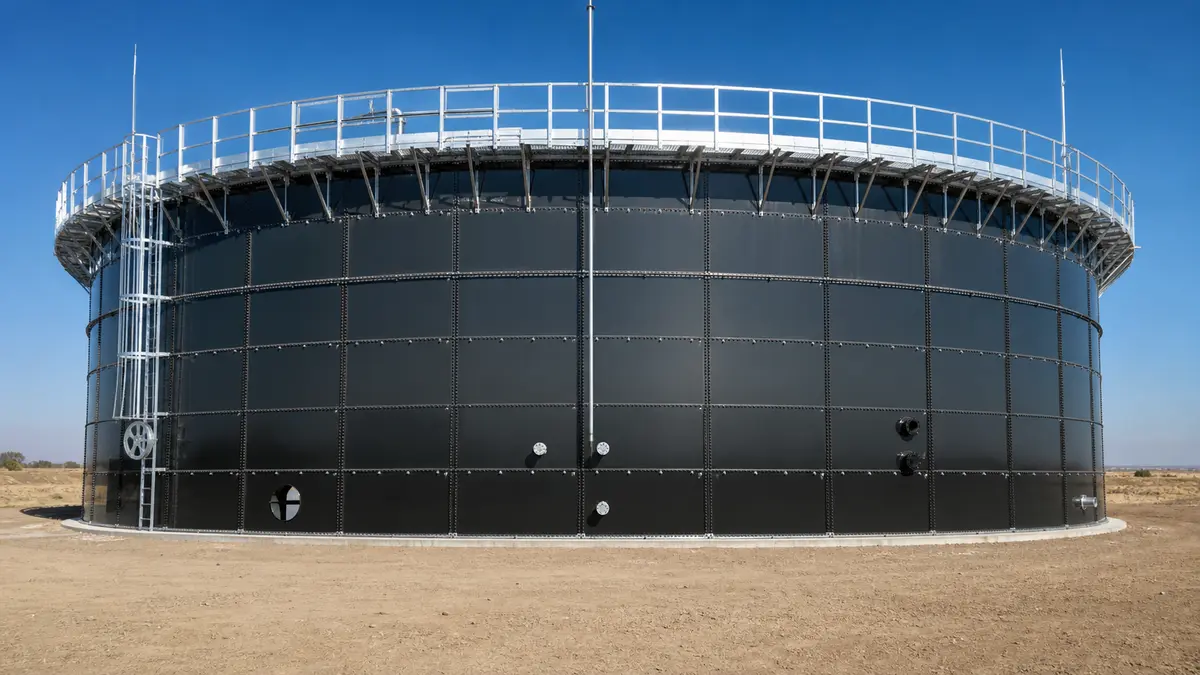
Project references for food and beverage wastewater storage, equalization, anaerobic treatment, biogas capture, and supporting industrial tank systems.
Food and beverage projects differ by raw material, production cycle, cleaning regime, organic load, fats and solids, temperature, and energy-recovery objective.
Food and beverage project references must be separated by process duty
Dairy, meat, sugar, starch, beverage, oilseed, fruit, and vegetable processing do not create the same wastewater. Flow variability, COD and BOD, fats, oils and grease, suspended solids, pH, temperature, cleaning chemicals, and production campaigns all affect tank duty and treatment configuration.
The project category therefore groups examples by process role rather than treating food-industry tanks as one product. Buyers can first review the food and beverage application guide and then use the cases listed under the main projects directory to identify the closest wastewater or biogas duty.
Food and beverage project comparison
Process factor
How it changes tank and project scope
Production source
Dairy, meat, sugar, beverage, starch, oilseed, or produce operations create different organic loads, solids, fats, temperature, and cleaning chemistry.
Tank role
Receiving, equalization, anaerobic digestion, sludge holding, treated-water buffer, emergency storage, or gas-holder duty require different accessories.
Corrosion and hygiene
Liquid chemistry, gas-space exposure, cleaning regime, odor control, roof type, drainage, and access determine material and inspection needs.
Biogas interface
Expected gas rate, methane, H2S, condensate, pressure buffering, flare or generator connection, and safety controls must be coordinated.
Project boundary
Process design, tanks, covers, mixers, piping, civil works, instruments, installation, testing, and commissioning should have named owners.
Start with the actual wastewater profile
A useful project comparison includes flow range, production schedule, COD and BOD, pH, temperature, fats, oils and grease, suspended solids, salinity where relevant, and cleaning or sanitation chemicals. Average values alone can hide shock loads produced during washdown, product changeover, or seasonal campaigns.
The storage or equalization tank should be sized and equipped around the treatment strategy. Mixing, recirculation, drainage, odor control, roof or cover, sampling, and cleanout may be more important than selecting the largest nominal volume. The project reference should show which function the tank performed in the process.
Distinguish liquid-storage projects from biogas projects
Anaerobic treatment can connect coated or glass-fused steel tanks with membrane covers, external gas holders, condensate management, desulfurization, flare systems, boilers, or generators. A gas-holder reference does not automatically prove wastewater-tank scope, and a liquid-storage reference does not establish gas-system capability.
Where energy recovery is planned, the RFQ should state expected gas production and variability, methane and H2S ranges, moisture, pressure requirement, utilization method, and control boundary. These values affect membrane, connection, pressure protection, instrumentation, and commissioning requirements.
Plan hygiene, maintenance, and odor controls
Food-sector wastewater can settle, foam, generate odors, and leave fats or solids on internal surfaces. Tank geometry, drainage, access, mixing, cleaning, venting, and safe isolation should suit the operator’s maintenance method. If chemicals used for cleaning can enter the tank, they belong in the compatibility review.
The owner should define whether a roof is used for rainfall exclusion, odor capture, process control, or gas collection. Each purpose creates different vent, seal, access, and safety interfaces. Project references are most valuable when these functions are explicit rather than presented as a generic covered tank.
Prepare a comparable project RFQ
A qualified inquiry includes production type, wastewater flow and chemistry ranges, tank role, usable volume, number of trains, roof or cover duty, mixers and drains, site loads, containment, process connections, inspection requirements, installation responsibility, and required records. State which process equipment is by others.
Use references to identify questions, not to copy dimensions. The current plant’s production profile, approval route, climate, maintenance capability, and civil layout still control the final design. Suppliers should state assumptions and exclusions so the buyer can compare equivalent technical scopes.
Next Step
Submit production type, wastewater and cleaning-chemical ranges, process role, usable volume, roof or gas duty, mixing and drainage needs, site data, interfaces, inspection, and installation scope.