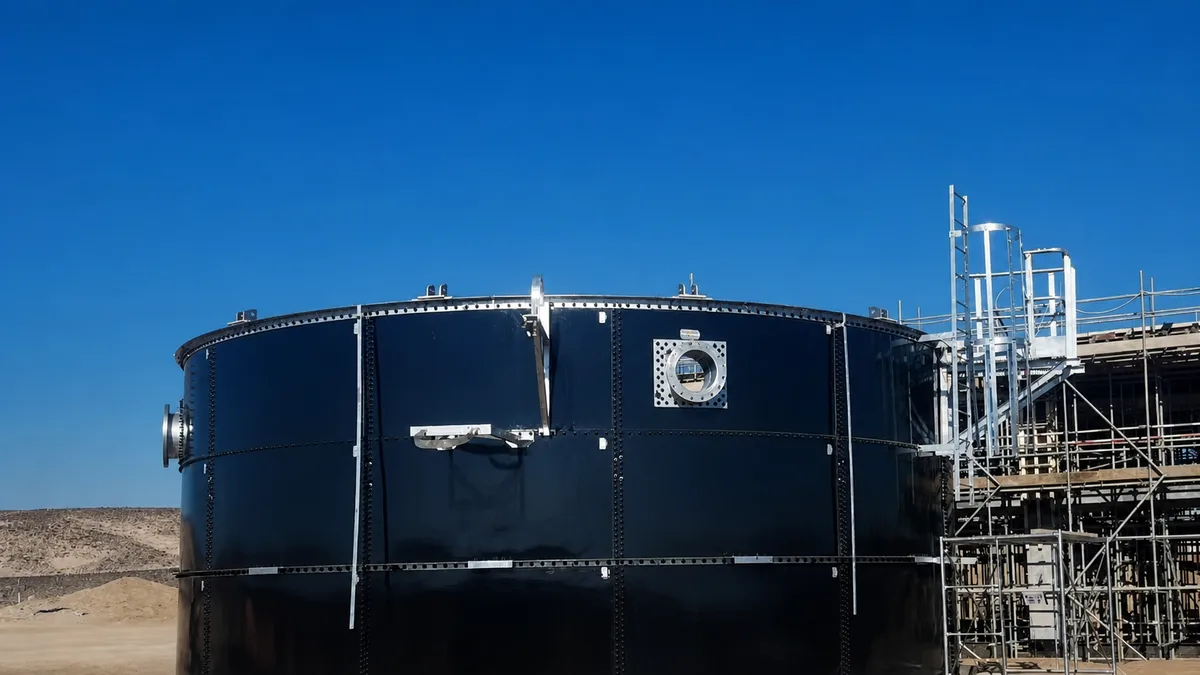
Review leachate storage tank projects for landfill leachate, high-corrosion wastewater, epoxy coated tanks, GFS tanks, chemistry review, and RFQ data.
Leachate projects should be reviewed around chemistry, vapor exposure, solids, coating compatibility, and inspection access.
Leachate projects require chemistry-first review
Landfill leachate storage projects are high-risk wastewater projects because chemistry can vary widely. pH, chloride, ammonia, COD, sulfides, solids, temperature, and cleaning methods can all affect corrosion protection.
A comparable reference records landfill type, leachate chemistry, pre-treatment or equalization role, tank capacity, roof or odor-control scope, inspection access, and any downstream treatment interface.
Leachate project data
Data point
Why it matters
Leachate chemistry
pH, chlorides, ammonia, COD, sulfides, salinity, temperature, and cleaning chemicals affect material choice.
Tank duty
Equalization, emergency reserve, treatment buffer, sludge interface, or process feed.
Vapor exposure
Condensation, odor, H2S, and ventilation affect roof and upper-shell corrosion.
Solids and cleaning
Sediment, sludge, manway access, drain design, and maintenance interval.
Documentation
Coating records, corrosion assumptions, inspection access, and maintenance notes.
Why leachate storage differs from ordinary wastewater
General wastewater pages often focus on flow buffering and treatment stability. Leachate projects need stronger chemistry review because landfill liquids can be more aggressive and less predictable.
A useful project reference should identify the corrosion assumptions and whether epoxy, GFS, stainless, liner, or other protection was considered.
Roof, odor, and vapor-space risk
Leachate tanks may require covers for odor, safety, rain exclusion, or process control. The vapor space can carry corrosion risk that is different from the liquid phase, especially when H2S or condensation is present.
Use the roof selection guide to define cover duty, vapor exposure, ventilation, loads, and inspection access instead of treating the roof as a generic accessory.
RFQ data for leachate projects
Send leachate analysis, capacity, tank duty, temperature, cleaning method, vapor conditions, roof requirement, mixer or aeration requirement, site loads, and inspection expectations.
If the chemistry is unknown, the quotation should be clearly marked preliminary until representative analysis is available.
Containment and treatment interfaces
The tank should be reviewed as part of the landfill water-management system. Inlet pumping, equalization, overflow routing, emergency storage, secondary containment, tanker loading, aeration or mixing, downstream treatment, and return flows can all affect working volume and nozzle arrangement. The owner should define whether rainfall ingress and abnormal collection-system events are included in the capacity basis.
Secondary containment and drainage requirements depend on local permits and site risk. The RFQ should identify bund or containment responsibility, leak detection, floor drainage, isolation valves, access for spill response, and whether the tank foundation must protect an underlying liner system. These interfaces should not be assumed from a previous wastewater project.
Inspection, cleaning, and lifecycle planning
Leachate can deposit solids and create aggressive liquid and vapor exposures. Plan low-point drainage, cleanout access, safe isolation, ventilation, confined-space controls, internal inspection, coating repair, and sediment removal before finalizing tank geometry. Roof and upper-shell areas deserve separate attention where condensation or H2S exposure differs from the bulk liquid.
The turnover package should record the design chemistry range, selected corrosion system, coating or lining inspection, holiday testing where specified, installation checks, leak or hydrostatic testing, repair procedures, and maintenance assumptions. Representative operating data should be reviewed again if landfill age, waste stream, treatment chemicals, or leachate recirculation changes materially.
Material selection must consider both continuous service and temporary upset conditions. A coating suitable for average leachate may not be suitable for concentrated returns, cleaning chemicals, elevated temperature, or a corrosive vapor space. The buyer should state credible chemistry limits and require the supplier to identify excluded conditions, repair limits, cure requirements, and compatibility assumptions in the technical offer.
Instrumentation and operating controls can reduce overflow and corrosion risk. Level measurement, independent high-level alarm, pump interlocks, sampling points, temperature monitoring, ventilation, and odor-control equipment should be coordinated with the tank nozzles and roof. The responsibility for cabling, control panels, hazardous-area review, and commissioning belongs in the project responsibility matrix. Alarm setpoints should be tied to usable volume, pump response time, overflow containment, and the operator action plan.
Standards and Reference Notes
Leachate treatment and storage requirements vary by landfill, country, permit, and treatment process. Final tank material selection should be checked against representative liquid data.
Next RFQ Steps
Send leachate analysis, duty, capacity, temperature, vapor condition, roof requirement, cleaning plan, site loads, and inspection access.