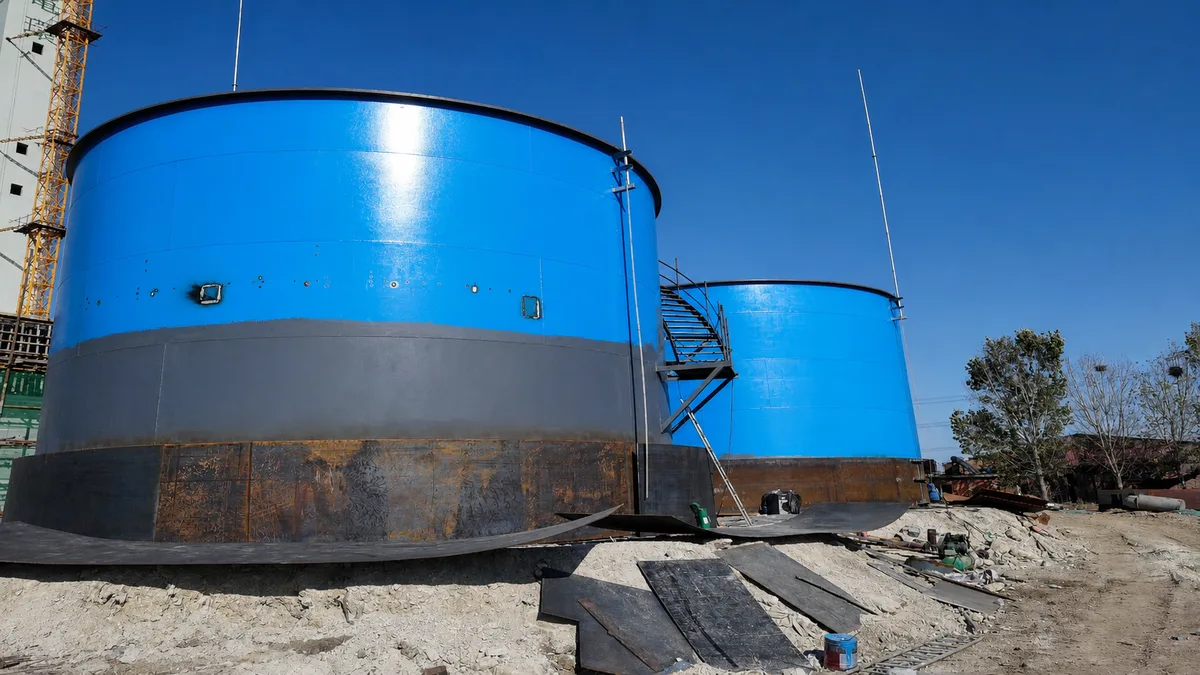
Review mining and process water tank projects for raw water, treated water, slurry-adjacent duty, industrial water, corrosion review, and RFQ data.
Mining and process water projects should document water chemistry, solids exposure, site access, corrosion duty, and operating role.
Mining and process water projects are site-driven
Mining and process water tank projects can include raw water, treated water, reclaimed water, slurry-adjacent service, utility buffering, and industrial wastewater support. The tank duty should be stated clearly before comparing product families.
A comparable reference documents water source, solids or slurry exposure, pH, chlorides, site access, remote installation constraints, foundation status, and whether the tank serves process feed, emergency reserve, or treatment buffering.
Mining and process water project inputs
Input
Why it matters
Water source
Raw, reclaimed, treated, process, mine water, or wastewater changes corrosion and solids review.
Process feed, reserve, equalization, cooling, washdown, or treatment buffer.
Remote execution
Transport route, unloading, lifting, site weather, foundation readiness, and local labor.
Material choice
Welded, bolted, epoxy coated, GFS, stainless, galvanized, or lined system selection.
Process role controls the project reference
A mining process water tank can be a clean utility buffer, a reclaimed water tank, or a solids-exposed process vessel. These duties need different corrosion, cleanout, nozzle, and maintenance decisions.
A good project reference should identify the operating role and not simply call the project a mining tank.
Corrosion, solids, and access
Mining and process water can contain chlorides, suspended solids, variable pH, reagents, or abrasive particles. The buyer should send water analysis and solids information before selecting coating or material.
Remote access can also affect tank type. Modular bolted tanks may reduce site welding, while welded systems may suit large fixed storage where local fabrication and inspection are available.
RFQ data for process water projects
Send capacity, water analysis, solids data, operating role, design standard, site country, wind and seismic data, nozzle list, roof requirement, foundation status, and installation boundary.
Process-water duty should be coordinated with the plant hydraulic profile. Pump suction levels, inlet momentum, overflow and emergency drainage, agitation, recirculation, solids settlement, cleanout, and minimum operating level affect usable capacity and nozzle positions. Mixer bridges, pipe supports, platforms, launders, or internal equipment introduce loads that must be identified before shell and roof design.
Abrasion risk depends on solids concentration, particle size, velocity, and cleaning method. A corrosion-resistant coating is not automatically an abrasion lining. The project team should distinguish clear water, suspended-solids water, slurry contact, and reagent exposure so material, lining, floor details, and inspection access can be assessed against the real service.
Remote execution and document control
Mining sites can impose transport limits, high altitude, extreme temperature, dust, limited lifting equipment, restricted work windows, and long replacement-part lead times. Packing plans, component identification, weather protection, storage before erection, local crew capability, supervision scope, and foundation survey records should be included in supplier comparison.
Handover should include approved drawings, design assumptions, material and coating records, fabrication or panel inspection, installation checks, test requirements, repair procedures, spare parts, and an agreed responsibility matrix. Site structural, environmental, worker-safety, and process requirements remain controlling; a previous mining reference does not replace project-specific engineering.
The capacity basis should be tied to the site water balance, not a standalone tank volume. Normal consumption, reclaim availability, storm or seasonal variation, process upset demand, fire or emergency reserve, pump availability, and planned plant expansion can change the required working volume. The quotation should distinguish present duty from future connection allowances so unused capacity and oversized nozzles are intentional decisions.
Where shutdown access is difficult, consider isolation, bypass, redundant storage, drain-down time, sediment removal, and internal inspection from the start. These requirements may affect tank count, floor slope, manway size, roof access, coating repair strategy, and whether the plant can continue operating while one tank is unavailable.
Standards and Reference Notes
Mining and process water projects should follow site engineering requirements, owner standards, and local safety rules. Process data must be verified by the project engineering team.
Next RFQ Steps
Send water source, chemistry, solids, capacity, operating role, site loads, roof need, nozzles, foundation status, and installation boundary.