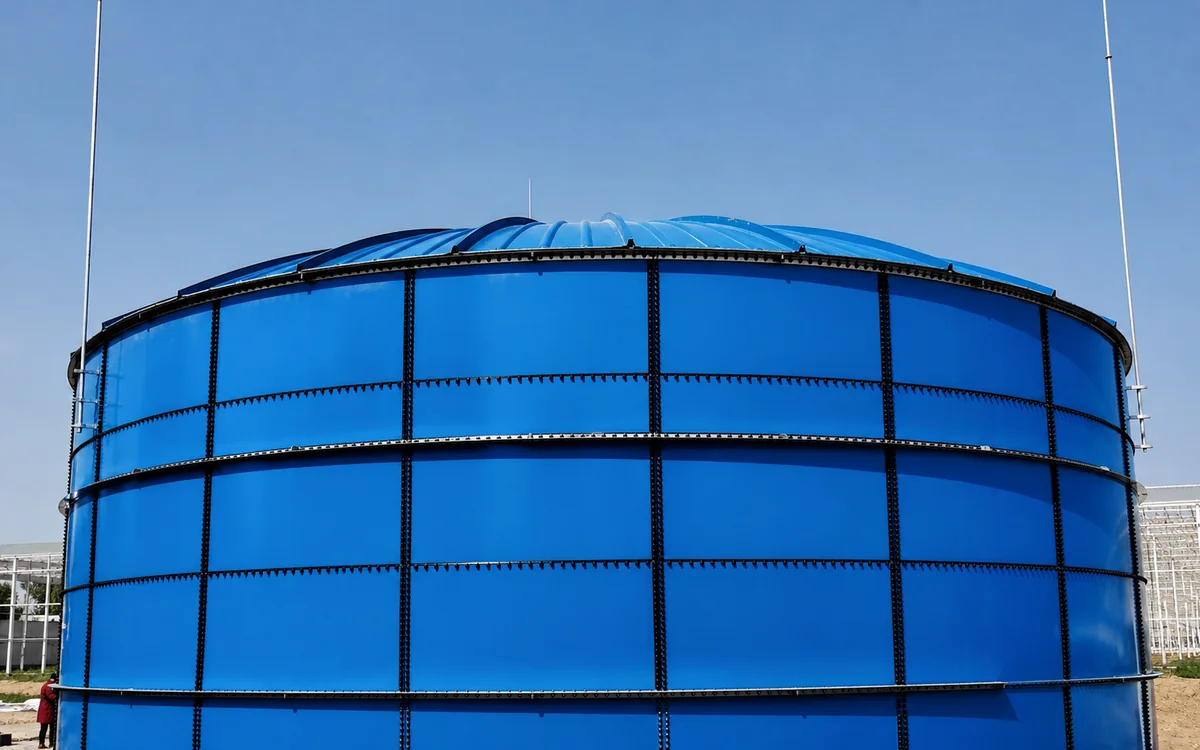
Landfill leachate storage tank guide for high-corrosion wastewater, epoxy coated tanks, GFS tanks, odor control, containment, covers, and RFQ data.
Leachate storage requires chemistry review, corrosion protection, odor control, containment planning, and safe access before tank selection.
Leachate storage is a corrosion-led tank duty
Landfill leachate storage tanks handle variable wastewater that can contain organics, ammonia, chlorides, sulfides, dissolved metals, suspended solids, and chemical changes driven by rainfall and landfill age. This makes leachate storage different from ordinary municipal wastewater buffer storage. A tank RFQ must start from chemistry, not only capacity.
For an industrial tank manufacturer, the tank selection usually compares epoxy coated steel tanks, glass-fused-to-steel tanks, selected stainless systems, or lined welded steel systems. The correct answer depends on pH range, chloride level, temperature, suspended solids, odor control needs, cover type, containment requirements, and inspection access.
Epoxy coated bolted tanks can be reviewed for leachate storage when the coating system is matched to the wastewater chemistry and the buyer needs modular field assembly. The RFQ should identify coating thickness, inspection method, holiday testing expectations, repair materials, gasket compatibility, and panel protection during export packing.
Glass-fused-to-steel tanks can also be considered for selected leachate or aggressive wastewater duties because the factory-fired coating provides a consistent surface. Suitability still depends on the actual chemical profile, cleaning method, abrasion risk, and project standards. Stainless steel may be selected for some corrosive or high-cleanability duties, but grade selection and fabrication records must be defined.
The product page for leachate storage tanks should be used for tank type comparison, while this application page should define landfill wastewater duty, operating data, and RFQ requirements.
Chemistry changes and lifecycle risk
Leachate chemistry can change by season, rainfall, landfill cell, biological activity, and treatment stage. A single pH value is not enough for tank selection. Buyers should provide ranges and identify worst-case conditions where possible. If lab data is incomplete, state whether the quotation is budget-stage or final procurement-stage.
High chlorides, sulfides, low pH, high temperature, or abrasive solids can shorten service life if the tank material and coating are selected too quickly. The quotation should include coating records, inspection points, nozzle protection, spare coating repair material, and maintenance access. These documents often matter more than a generic claim that the tank is corrosion resistant.
Odor, cover, and site interface
Leachate tanks may require covers for odor control, rainwater exclusion, safety, or process control. Aluminum dome roofs, fixed steel roofs, or membrane covers can be reviewed depending on tank diameter, odor system, venting, corrosion exposure, and maintenance access. Cover selection should be coordinated with the storage tank roofs page.
Site layout matters. The buyer should define truck unloading, pump suction, level control, overflow routing, drainage, secondary containment, foundation scope, and emergency bypass. Leachate storage is often part of a treatment system, so the tank vendor, process designer, civil contractor, and operator should have clear scope boundaries.
Plan equalization, solids control, and monitoring
A leachate tank may be passive storage, an equalization basin, a feed buffer, or part of a treatment stage. The process designer should define turnover, expected level cycle, settling behavior, pump suction, recirculation, mixing or aeration, foam allowance, sampling, and whether biological activity or gas generation is credible. Mixer loads, aeration piping, access bridges, instruments, and large nozzles must be included before structural engineering rather than added after the tank is purchased.
Monitoring data helps manage a variable waste stream. Useful parameters can include level, temperature, pH, conductivity, flow, and chemistry samples selected by the treatment operator. High-level and overflow response should coordinate with containment and emergency storage. The owner should also plan isolation, drainage, ventilation, confined-space controls, cleaning, coating inspection, and temporary storage during maintenance so the tank can be taken out of service without bypassing environmental safeguards.
RFQ data for landfill leachate projects
A complete RFQ should include tank volume, leachate source, chemistry ranges, temperature, solids, odor requirement, cover type, nozzle schedule, mixing or aeration, containment, site loads, installation responsibility, and required inspection records.
Project pages such as leachate storage projects can support buyer research, but the final specification should be built from actual leachate data and operating conditions.
Standards and Reference Notes
Leachate projects should be checked against local environmental, containment, safety, and operator requirements. Tank material and coating should not be finalized until wastewater chemistry and site duties are confirmed.
Next RFQ Steps
Send leachate chemistry, volume, tank function, cover and odor needs, containment, nozzles, mixing, site loads, coating expectations, inspection records, and installation scope.