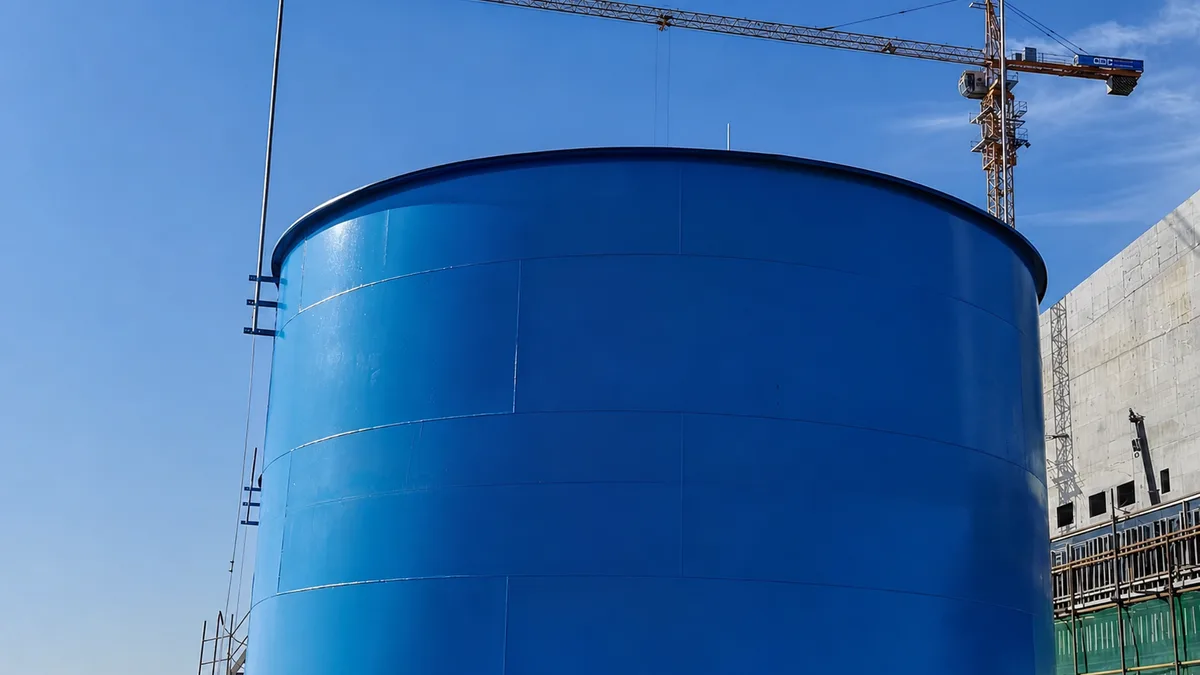
Review industrial storage tank projects for bulk liquid storage, process water, chemical service, coating selection, roof systems, and RFQ data.
Industrial storage projects should be grouped by stored media, corrosion duty, operating role, and site execution limits.
Industrial storage project references need more than a tank photo
Industrial storage tank projects may involve process water, cooling water, bulk liquid storage, specialty chemicals, industrial wastewater, utility buffering, or plant expansion work. A useful project reference should explain the stored media, tank role, material or coating route, roof requirement, and installation conditions instead of only listing a tank capacity.
For high-ticket projects, the buyer should separate budget assumptions from final engineering data. Early inquiries can use estimated capacity and media, but order release should confirm liquid chemistry, temperature, design standard, wind and seismic basis, nozzle schedule, roof type, inspection scope, and installation boundary.
Industrial project comparison points
Project factor
What to confirm before supplier comparison
Stored media
Process water, chemical liquid, wastewater, fuel, slurry, or utility water changes material and corrosion decisions.
Tank role
Buffer, equalization, reserve, process feed, emergency storage, or bulk inventory duty affects working volume and accessories.
Construction type
Compare welded, bolted, GFS, epoxy coated, stainless, galvanized, or carbon steel systems against site and lifecycle needs.
Roof and venting
Open top, fixed roof, aluminum dome, floating roof, or covered odor-control designs change project scope.
Execution limit
Remote installation, lifting access, shutdown window, foundation readiness, and export packing affect real delivery risk.
How to read industrial storage references
Industrial storage references are most useful when they identify the operating problem solved by the tank. A process-water buffer tank, a chemical storage tank, and a bulk industrial liquid tank can look similar from outside, but their coating, nozzle layout, roof, venting, and inspection requirements may differ greatly.
Buyers should compare references by duty and risk rather than only by tank size. For example, a high-capacity welded tank reference may be relevant for fixed-site bulk storage, while a bolted epoxy or GFS tank reference may be more useful where modular delivery and site assembly are important.
Material and coating review
The project media should drive the first material discussion. Carbon steel, stainless steel, galvanized steel, epoxy coated panels, GFS panels, and lined welded systems all have different limits. Chemical concentration, chloride level, temperature, solids, cleaning chemicals, and UV exposure should be sent before coating selection.
If corrosion risk is unclear, use the coating comparison guide and corrosion protection resource before requesting a final quote. This reduces the chance of receiving a price that cannot survive detailed engineering review.
RFQ structure for industrial storage projects
A strong RFQ for industrial storage should include tank count, working volume, design liquid level, stored media, density, pH, temperature, design standard, roof scope, nozzle list, mixer or platform requirement, foundation status, site location, and whether installation supervision is needed.
Industrial storage projects need a defined inspection and document boundary before fabrication starts. Depending on the construction route, the package may include material certificates, weld and NDT records, coating or lining inspection, panel checks, dimensional reports, leak or hydrostatic testing, packing lists, installation instructions, and as-built drawings. The RFQ should state which records require buyer review, third-party witnessing, or final data-book inclusion.
The operating boundary is equally important. The tank supplier needs to know whether mixers, heating coils, insulation, level instruments, vents, pressure-vacuum devices, pumps, piping supports, secondary containment, and access platforms are in the tank scope or supplied by others. Defining these interfaces early prevents omissions and avoids comparing quotations that include different equipment packages. It also gives the commissioning team a clear basis for checking mechanical completion before liquid is introduced.
Standards and Reference Notes
For occupational safety context around industrial chemical communication, OSHA Hazard Communication is a United States regulatory reference and is not a global tank design standard. Local project rules, owner specifications, and applicable storage tank standards still control the final project.
Next RFQ Steps
Send stored media, capacity, temperature, pH, density, roof requirement, nozzle schedule, foundation status, site country, and installation boundary for an industrial storage project review.