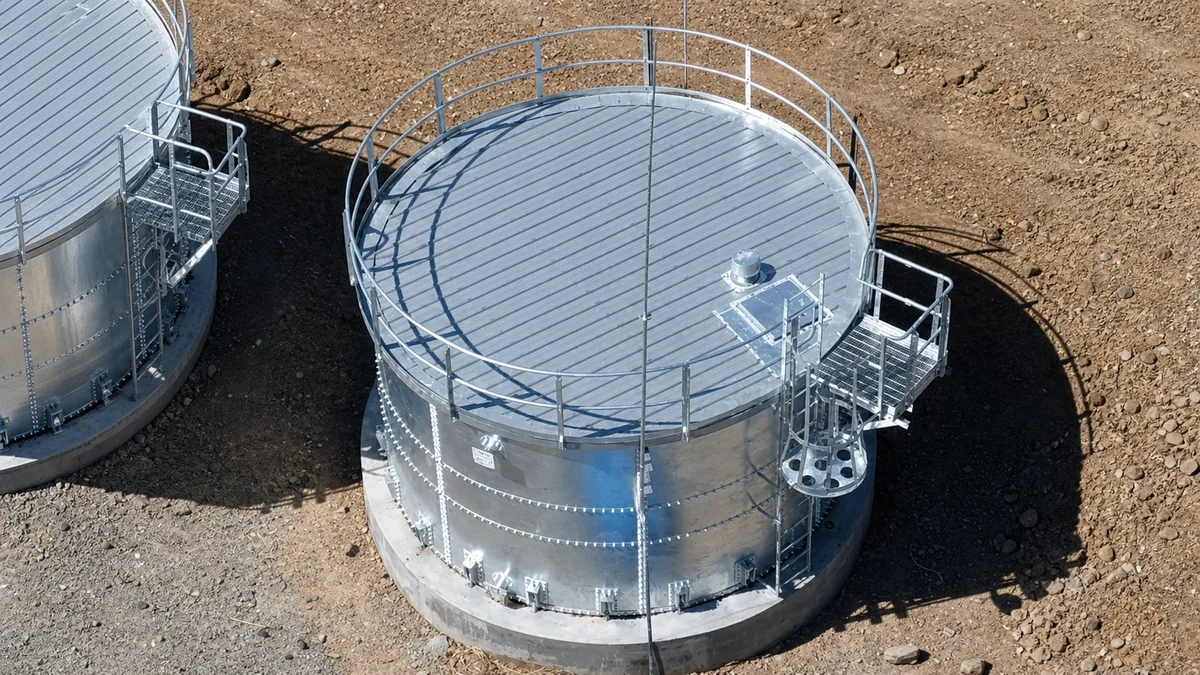
Review petrochemical storage tank projects for fuel storage, floating roofs, welded steel tanks, corrosion review, fire water interfaces, and RFQ data.
Terminal storage projects may include product tanks and separate utility or fire-water tanks; each duty requires its own design basis.
Petrochemical projects must separate tank duty from safety systems
Petrochemical and oil storage projects may include crude oil, fuel oil, diesel, gasoline, aviation fuel, biofuels, petrochemical feedstocks, emergency fuel reserves, and terminal support tanks. These projects require a stricter RFQ than ordinary water storage because volatility, fire protection, vapor control, corrosion, and local safety rules can strongly affect the tank configuration.
A petrochemical project inquiry should identify the stored product, flash point or volatility category where available, tank location, required design standard, roof type, fire water interface, venting, corrosion allowance, coating or lining, and inspection package.
Petrochemical project review points
Project item
RFQ review requirement
Stored product
Crude oil, diesel, gasoline, aviation fuel, biofuel, solvent, or petrochemical feedstock each affects risk review.
Tank standard
Confirm owner-specified standard, local code, and whether welded steel, bolted steel, or special roof systems are acceptable.
Roof system
Fixed roof, internal floating roof, external floating roof, aluminum dome, or vapor-control cover must match stored product and emissions strategy.
Fire protection
Fire-water demand, foam interface, terminal layout, and emergency reserve should be coordinated separately from the storage tank itself.
Inspection package
Material certificates, weld/NDT scope, coating inspection, hydrotest, and handover documents should be defined early.
Fuel and oil project categories
Fuel and oil tank references should not be treated as interchangeable. A diesel reserve tank, gasoline storage tank, crude oil tank, and aviation fuel tank can require different roof, venting, material, inspection, and safety reviews. Even when the tank shell material is similar, the operating duty can change the project scope.
When a buyer is reviewing above-ground fuel storage, the early discussion should include whether a floating roof, fixed roof, dome cover, or vapor-control system is required. The roof selection guide should be used before finalizing roof scope.
Fire water and terminal interfaces
Petrochemical terminals often include both product storage tanks and fire water tanks. These are related but separate systems. Fire water tank requirements may involve emergency reserve, pump suction, reliability, and inspection access, while product tanks focus on stored product risk, roof, venting, and containment.
Project references establish the operating context, while the linked product and technical guides provide the detailed selection criteria for welded tanks, floating roofs, carbon steel tanks, and fire-water systems. Buyers should use both levels when preparing a comparable supplier scope.
For final quotations, send stored product data, capacity, design pressure assumptions, roof type, site wind and seismic data, foundation condition, inspection requirements, and any owner-specified standards.
Containment, venting, and inspection interfaces
The tank specification should be coordinated with secondary containment, drainage, overfill prevention, venting, vapor control, earthing or bonding, access control, and the site fire-protection strategy. These systems may be designed by different disciplines, but their interfaces affect nozzle locations, roof penetrations, operating levels, inspection access, and the usable tank volume.
For welded storage tanks, the buyer should define material traceability, welding procedure approval, welder qualification, NDT extent, dimensional checks, bottom and shell testing, coating or lining inspection, and the final turnover package. The exact scope follows the adopted standard and owner specification; it should not be inferred solely from the phrase "API tank" or from a previous project photograph.
Brownfield terminal work also needs an execution review covering shutdown windows, nearby operating equipment, hazardous-area controls, lifting routes, foundation condition, and tie-in responsibility. These constraints can determine whether field-welded, shop-fabricated, or modular construction is practical.
Standards and Reference Notes
The API standards catalog identifies petroleum-industry documents such as API 650, but the applicable edition and standard must be stated in the contract. API and NFPA references may apply to some projects; they are not automatically global requirements and do not replace buyer-country rules or owner specifications.
Next RFQ Steps
Send stored product, tank capacity, standard requirement, roof type, site loads, fire water interface, coating or lining needs, and inspection package for review.