
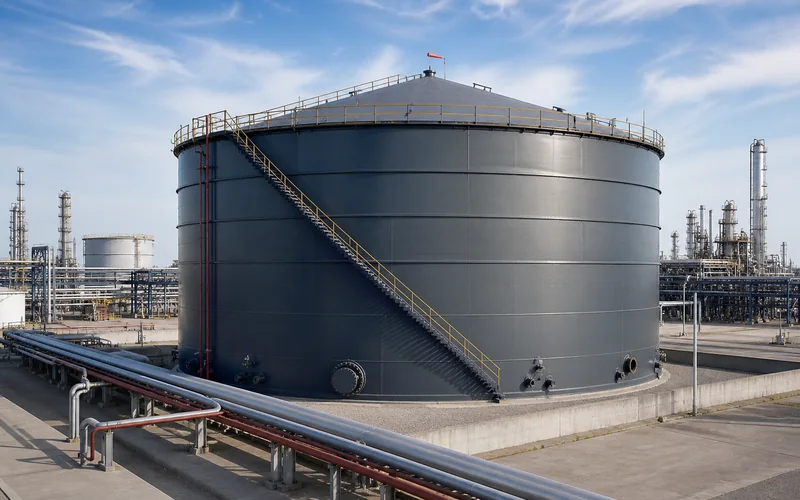
Aviation fuel storage is a quality-critical tank duty
Aviation fuel storage is not only a capacity problem. The tank must protect product quality, control water and sediment risk, support inspection, and connect safely to filtration, transfer, and loading systems. A buyer should not accept a quotation that only lists tank volume and steel thickness.
Welded steel tanks are often reviewed for aviation fuel and refined petroleum storage where the project requires a recognized design basis, site-built construction, appurtenance control, and inspection documentation. Buyers can start from the site’s welded steel tanks page, then define the aviation fuel-specific details listed here.
The final specification should be prepared by the project engineer and fuel-system specialist. This guide organizes the tank-side RFQ data so supplier comparison is more technical and less price-only.
Aviation Fuel Storage RFQ Data
| RFQ Item | Why It Matters |
|---|---|
| Fuel type and quality controls | Jet fuel grade, water separation approach, sediment control, sampling, drain points, and filtration interface affect tank accessories. |
| Tank standard and design basis | API 650 or other required standard, design temperature, product density, roof type, and local approval route must be defined. |
| Internal surface and coating | The buyer should review whether internal coating, lining, or bare steel is appropriate for the fuel system and owner specification. |
| Bottom and drainage details | Water draw-off, sump, slope, drain nozzle, and inspection access are critical for maintaining product quality. |
| Fire protection and safety interfaces | Foam, vents, emergency relief, grounding, bonding, overfill protection, and firefighting access should be coordinated before fabrication. |
Product quality changes the tank details
Aviation fuel systems must control water, sediment, and contamination. The tank RFQ should therefore define drainage, sampling, access, and cleaning requirements. These details may affect bottom design, nozzle elevations, manway size, and internal coating decisions.
If a supplier receives only capacity and diameter, the quotation may omit key fuel-system interfaces. The buyer should provide a piping and instrumentation concept or at least a nozzle list showing inlet, outlet, recirculation, drain, sampling, level instruments, and vents.
Inspection and documentation expectations
A strong aviation fuel tank quotation should identify material certificates, welding procedure requirements, nondestructive testing, dimensional inspection, coating inspection, hydrotest procedure, and drawing approval workflow. These items affect schedule and quality control.
For export projects, the buyer should also clarify whether the supplier supports local installation, site welding, coating repair, and commissioning documents. Aviation fuel storage often requires stricter document control than ordinary water storage.
Price should be tied to scope
A low price can be misleading if it excludes internal coating, roof accessories, nozzles, ladders, platforms, fire protection connections, or inspection. Buyers should request a line-by-line scope so the total project cost can be compared correctly.
When the budget is still preliminary, ask for a budgetary quotation with explicit assumptions. This is more professional than asking for a universal price per cubic meter, which cannot reflect product quality or inspection requirements.
Aviation fuel storage is a quality-critical tank duty: Codes and Evidence
For welded steel oil storage standards, use the official API standards portal to confirm the relevant standard and edition. Aviation fuel handling requirements should also be reviewed with the fuel-system designer and local authority.
Procurement Review for aviation fuel storage
Before placing an order, the buyer should ask the supplier to confirm the engineering assumptions, included accessories, excluded items, inspection records, packing method, installation boundary, and document submission schedule for aviation fuel storage. This prevents a low headline price from hiding missing nozzles, platforms, coating work, supervision, or approval documents.
The commercial comparison should separate the tank shell, roof or cover, internal and external protection, appurtenances, freight, installation support, spare parts, and commissioning documents. If two quotations do not use the same scope, they should not be compared as if they describe the same tank package.
Buyers should also ask how design changes are controlled after approval drawings are released. A late nozzle change, platform revision, coating change, or site-load update can affect fabrication, packing, delivery, and installation. A professional supplier should explain how revisions are reviewed, priced, documented, and reflected in the final drawing package.
The final order file should keep approved drawings, inspection records, packing lists, installation notes, and any agreed deviations together, so the site team can verify the delivered tank against the purchased scope.
For long-life storage assets, the order should also identify the recommended inspection interval, spare parts, repair materials, and contact route for technical support after commissioning.
This review should be completed before production release, when design corrections are still practical and inexpensive.
RFQ Preparation
Send fuel type, capacity, design standard, drainage and sampling needs, nozzle list, fire protection interface, coating requirement, inspection scope, and installation boundary for aviation fuel tank pricing.