
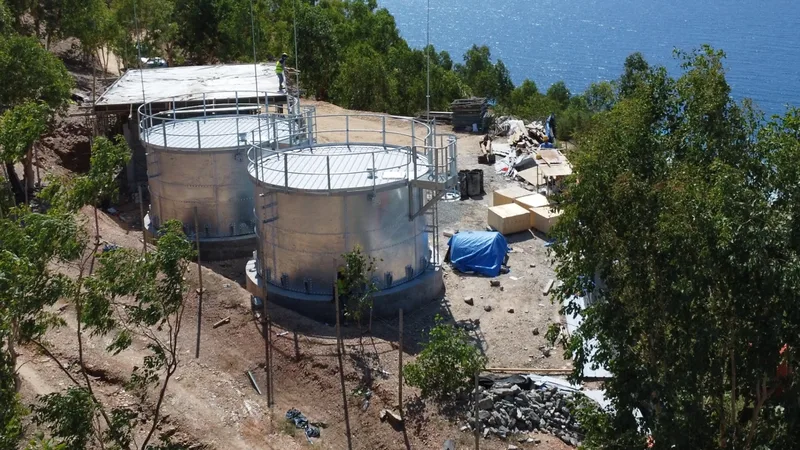
Site access can decide whether a fire water tank project stays on schedule
Warehouse fire protection projects often focus on capacity, pump flow, and approval documents, but the tank package can be delayed by practical site issues: road access, crane position, foundation readiness, anchor layout, unloading space, and safe storage for panels and accessories.
For a fire water tank used in a warehouse or logistics facility, the tank supplier should review the civil interface and installation route before finalizing a quotation. This is especially important for bolted tanks, galvanized tanks, and remote export projects where a missed accessory or access issue can create field delays.
This guide helps buyers prepare a stronger RFQ before comparing suppliers. It is not a substitute for the authority having jurisdiction or the project fire protection engineer; final design should follow the applicable local fire code, owner specification, and recognized standards such as NFPA 22 where required.
Warehouse Fire Water RFQ Inputs
| Input | Why It Matters |
|---|---|
| Usable capacity and reserved volume | Fire water tanks normally need a confirmed usable volume, not only nominal tank size. Freeboard, low-level limits, and suction arrangement affect actual available water. |
| Site access and lifting plan | Panel delivery, crane or forklift access, temporary storage, and installation sequence should be reviewed before shipment. |
| Fire system interface | Confirm suction nozzle, overflow, fill line, drain, level instruments, anti-vortex details where specified, and pump room connection. |
| Approval and inspection documents | Local code, owner documents, coating or galvanizing records, installation manual, and hydrotest or commissioning requirements should be defined early. |
| Freeze protection and climate exposure | Cold regions may require heating, insulation, circulation, or building enclosure review; hot or coastal regions may need different corrosion and ventilation assumptions. |
| Maintenance access | Confirm ladder, platform, roof access, internal inspection route, drain-down method, and safe access for periodic inspection. |
When galvanized steel tanks make sense
Galvanized steel tanks can be reviewed for fire water storage where the stored medium is clean water and the project environment matches the material and coating assumptions. Buyers should still confirm water quality, external exposure, roof type, bolt and gasket selection, and whether internal liner or coating details are needed.
A comparison with galvanized steel tanks should include service life expectations, inspection access, spare parts, and repair method. The material choice should be part of a fire protection system review, not a standalone price decision.
Coordination before shipment
Before panels are packed, the buyer should freeze tank diameter, height, nozzle schedule, roof accessories, ladders, platforms, anchors, and interface drawings. Late nozzle changes can affect panel fabrication, packing, and installation sequence.
The RFQ should also identify whether the supplier provides installation supervision, full installation, or only tank materials. For projects where the buyer uses a local contractor, a clear installation guide and remote technical support plan should be requested with the quotation.
How this connects to the technical RFQ
A fire water tank quotation is stronger when capacity, site conditions, and approval requirements are submitted together. The RFQ data checklist can be used to organize drawings, loads, coating requirements, accessories, and project schedule before contacting suppliers.
For projects with complex wind, seismic, coastal, or high-temperature conditions, buyers should ask for the design standard and site load basis in writing. This makes supplier comparison more transparent and reduces approval-cycle friction.
Approval documents should be settled before purchase
Fire water tanks are often reviewed by the project fire protection engineer, insurer, owner, or local authority. A buyer should not wait until after tank fabrication to ask for approval drawings, design basis, material information, installation instructions, or inspection documents. These documents should be listed in the commercial offer.
The RFQ should state whether the tank must satisfy a named code or standard, whether third-party review is required, and whether the supplier must provide calculations or only product documentation. This avoids a common problem: the purchased tank materials arrive on site before the approval package is complete.
Budget signals without publishing misleading prices
A responsible fire water tank supplier should avoid giving a generic price per cubic meter without design context. The final cost can change with tank diameter and height, roof type, coatings or galvanizing, seismic and wind load, nozzle count, access structures, packing, freight, local installation labor, and inspection scope.
For early budgeting, buyers can submit two or three capacity options with the same project assumptions. This allows a supplier to show how size, height, roof, accessories, and shipping affect price without pretending that one universal number applies to every warehouse project.
Standards and Reference Notes
For private fire protection water tanks, NFPA 22 is a key reference standard for tank design, construction, installation, and maintenance. Use the official NFPA 22 standard page to verify the current scope and edition required by the authority having jurisdiction.
If the same site also includes potable or process-water storage, do not reuse fire-water assumptions automatically. Drinking-water contact materials may need separate review under standards such as NSF/ANSI/CAN 61, depending on the project country and owner specification.
RFQ Preparation
For warehouse fire water tank pricing, send usable volume, project country, site loads, tank location drawings, nozzle schedule, approval standard, installation scope, and preferred delivery schedule.