
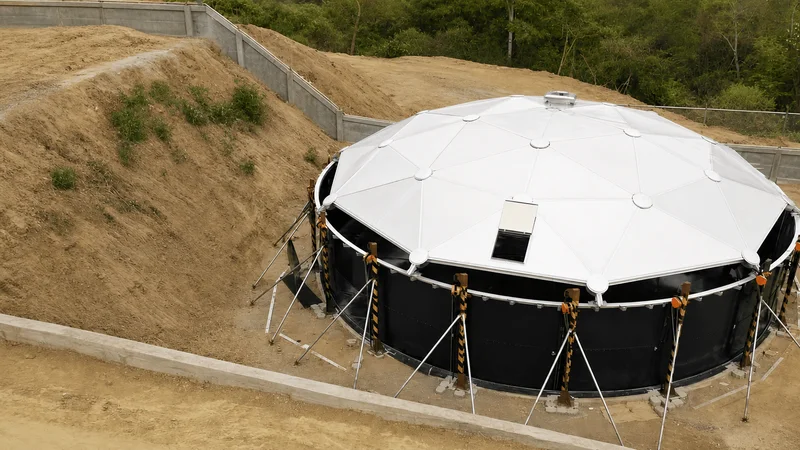
A Cover Is an Operating Decision, Not a Decorative Add-On
Mining process-water tanks can serve raw-water reserve, recycle water, reclaim water, slurry support, dust-control supply, washdown, or treatment interfaces. A cover can reduce debris entry, limit wind-blown dust, provide weather protection, improve safety control, and support a water-quality objective. But it also changes access, ventilation, inspection, lifting, roof loads, and the way the operator responds to overflow, foam, gases, or maintenance work.
The first question is what the tank stores and how the water will be used. A cover for recycled water with solids is different from a cover for treated make-up water, and both differ from a cover over a tank connected to a process that can release gases. The project team should define the water chemistry, solids, temperature, expected vapor or gas conditions, maintenance plan, and the owner requirements before selecting a roof family.
For application-level tank selection, start with the mining and process water page. For a product-level roof comparison, continue to the storage tank roofs guide. This article supports those pages with a focused cover-selection path rather than repeating their general tank content.
Mining Tank Cover Review Matrix
| Review area | Questions for the project team |
|---|---|
| Stored water | Raw, recycle, reclaim, treated, slurry-bearing, washdown, or process water; solids, chemistry, temperature, and odor or gas potential. |
| Environmental exposure | Dust, debris, wildlife, rainfall, snow, wind, sunlight, evaporation, temperature range, corrosion, and site altitude where relevant. |
| Operational access | Inspection frequency, sampling, mixer and pump maintenance, lifting route, rescue access, fall protection, lighting, and lockout procedure. |
| Roof interface | Ventilation, pressure/vacuum protection where required, roof penetrations, handrails, nozzles, roof loads, drains, and compatibility with internal equipment. |
| Supply boundary | Tank shell, roof, access steelwork, instruments, electrical work, civil interfaces, freight, erection, test, documents, and commissioning. |
Match the Cover to Water Quality and Site Exposure
Dust and debris are common reasons to cover a mining water tank, but they are not the only design drivers. Solids in recycle water can affect internal cleaning and roof penetration layout. Water with odor, dissolved gases, treatment chemicals, or temperature variation may need a different ventilation and materials review. The cover selection should document what it is expected to control and what it is not expected to control.
Wind, rain, sunlight, airborne dust, wildlife, and corrosion can affect both the roof and the operating water quality. The owner should provide the project environmental basis, not rely on a generic statement that a roof is “weather resistant.” The tank and roof supplier can then evaluate structural loads, drainage, access, materials, and installation constraints against the specific site conditions.
Keep Inspection and Maintenance Practical
A cover should not prevent the operator from sampling water, inspecting internal equipment, maintaining mixers or instruments, removing debris, or responding to an abnormal operating condition. Define hatch locations, access paths, handrails, fall protection, lifting points, lighting, ventilation requirements, and the permit-to-work route before finalizing the roof arrangement. These are operational controls, not details to be added after the roof is ordered.
Roof penetrations need coordination with columns, mixers, level instruments, vents, inlets, overflow, pipe supports, and any internal equipment. Each opening can affect structural detail, sealing, drainage, inspection, and future replacement. The correct arrangement is specific to the tank diameter, roof family, internal equipment, and maintenance philosophy.
- Define all roof penetrations and future maintenance openings before fabrication.
- Confirm how rainwater or debris is managed around hatches and access routes.
- State whether the stored water can create a ventilation or confined-space consideration.
Select the Roof Family With the Tank System
A fixed roof, geodesic dome, floating roof, or membrane system serves different operating conditions. The roof should be selected with the tank shell, stored medium, process interface, and owner requirements rather than only from appearance or initial price. An aluminum dome roof is one roof family; it does not establish that the same solution is suitable for every mining water duty.
The tank design should also preserve a clear interface with drainage, overflow, vents, access platforms, instrumentation, and safety systems. If the project has an odor-control or gas-management duty, use a specialist process review. A nominal cover may not be a pressure-rated enclosure or a gas holder.
Prepare the RFQ Around the Real Operating Case
The RFQ should identify the water duty, solids and chemistry, design environmental loads, roof type, penetration schedule, access requirements, inspection and maintenance plan, tank geometry, site constraints, and supply boundaries. It should also state whether the tank is new, a retrofit, or part of an operating plant where downtime and construction access are limited.
For a complete design and installation preparation path, review the RFQ data checklist. A comparable quotation will show which loads, roof components, access features, erection activities, and documents are included instead of treating the cover as an isolated item.
Data to Include in the RFQ
A mining process-water tank cover RFQ should describe the stored water, site exposure, roof loads, access needs, penetrations, operating constraints, and installation boundary.
- Water duty, chemistry, solids, temperature, gas or odor potential, required water quality, and any treatment interfaces.
- Tank diameter, height, normal levels, internal equipment, nozzles, roof penetrations, vents, overflow, drains, and access requirements.
- Wind, snow, seismic, ambient range, dust/debris exposure, corrosion environment, site altitude, and local approvals.
- Roof family, structural and drainage requirements, hatch schedule, handrails, fall protection, lifting, lighting, inspection, and maintenance philosophy.
- Retrofit or new-build status, site access, crane/lifting constraints, operating shutdown window, erection boundary, and safety procedures.
- Inspection, test, document handover, installation records, operating guidance, maintenance plan, and spare parts requirements.